What it's like to build your own watch.
It's slower than you'd think. Quieter. More deliberate. There's a moment — usually about three hours in — where the parts in front of you stop being parts and start being a watch. This is what happens between arriving and leaving.
The first hour — picking
You arrive at the workshop in Surry Hills. The bench is laid out, a movement mat in front of your stool, the tools already arranged in the order you'll need them. We sit you down, walk you through what's about to happen, and then point you at the parts library.
This is where the first surprise happens. You thought you'd come in with a specific watch in your head — maybe a vintage diver, maybe a Datejust homage. You start picking up dials and holding them against cases, hands against dials, bracelets against the whole assembly. The watch you imagined isn't the watch your hands are gravitating toward. The combinations you keep coming back to are darker, or softer, or busier than what you originally pictured.
Most students take 20–30 minutes to commit. Some take longer. We don't rush this part. The watch you choose on the day is the watch you'll wear for years; getting it right matters more than getting it fast.
The second hour — the movement
Once you've picked your parts, the movement comes out. A small Seiko NH35 (or NH36, or NH38, or whichever you chose), about the diameter of a coin, sitting on the mat in front of you.
We walk through what's inside it — the mainspring, the gear train, the escape wheel, the pallet fork, the balance wheel. You can see the balance oscillating, three times a second, audibly ticking through your loupe. There's a quality of focus that emerges here, in the room, when everyone is looking at the tiny moving parts of their own movement. The conversation thins. The instructor moves between benches answering questions but the students themselves go quiet.
You remove the stem. You orient the date wheel. You begin the slow, careful work of seating the dial onto the movement — three small posts dropping into three small holes. The dial is the size of your thumbprint. The feet are smaller than a sewing pin. The whole world narrows.
The third hour — the hands
Hand-setting is where the build earns its hour. Three hands — hour, minute, seconds — fitted one at a time, in that order, each one requiring perfect alignment and exactly the right amount of pressure. Too much pressure and the hand seats too deep. Too little and it sits too high. Wrong rotation and the watch won't tell the right time.
This is the part of the class we sit closest. The instructor watches each hand go on. Holds your wrist steady on the press if needed. Says "lower" or "good" or "lift it back off, the angle is off."
Time stretches here. Twenty minutes can feel like an hour. The watch that was a movement and a dial fifteen minutes ago is now starting to look like a watch — three hands sitting flat above the dial, three pinions stacked at the centre. You can read the time, or you would be able to, if the watch were running.
"The watch that was parts thirty minutes ago is now a watch. You can read the time. It is exactly the time. You did this."
The fourth hour — the case
You re-insert the stem, drop the movement-and-dial assembly into the case, fit the crown, screw down the caseback. Suddenly the watch is a watch. Not in concept — physically. You can hold it. You can turn it over. You can see the rotor swinging through the display caseback as you tilt the case.
The instructor regulates it on the timegrapher while you watch. Three numbers come up on the screen — rate, amplitude, beat error. Small adjustments to the regulator lever, a re-test, a few more clicks of adjustment, a final test. The watch is set to within ±5 seconds per day. It will keep this rate for years.
The last 20 minutes
You fit the bracelet. The spring bars click into place. The bracelet swings freely on the lugs. You wind the watch — about 30 turns of the crown — and watch the second hand begin its slow, smooth sweep. You set the time against your phone. You set the date.
You put it on your wrist.
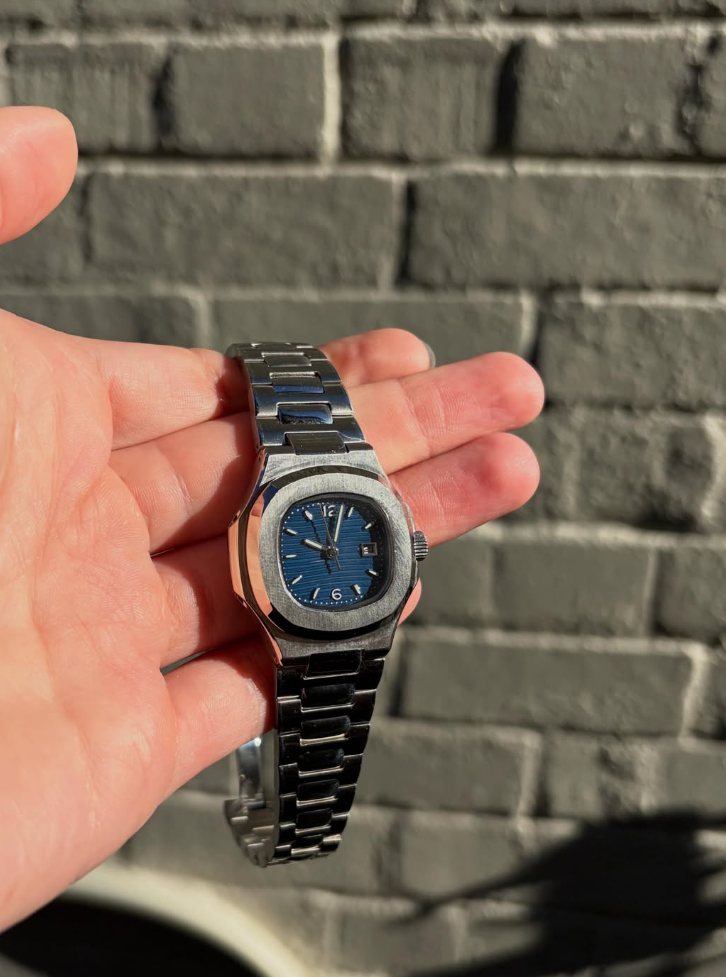
And then there's the moment. Different for everyone. Sometimes a quick look at the instructor; sometimes a long stare at the watch on your wrist; sometimes an exhale. The watch that was parts thirty minutes ago is now a watch. You can read the time. It is exactly the time. You did this.
What stays with you afterward
You walk out into Surry Hills with the watch on your wrist. The afternoon sun is doing whatever it's doing. Coffee shops are open. Wine bars are warming up for dinner. You can feel the watch's weight in a way you've never quite felt a watch's weight before — because every gram of it is something you handled, every choice it represents is something you made, every tick of the seconds hand is happening because of work you did at a bench an hour ago.
Most students wear the watch every day for the next several months. Some never take it off. Almost everyone tells us, in the weeks afterward, that the watch sits differently on their wrist than any other watch they've owned. It's not vanity. It's the particular weight of an object you understand.
Who comes to do this
The full range. Couples in their late twenties using the class as a date. People in their fifties who've collected watches for decades and finally want to build one. Brothers as a bucks-party gift to the groom. A wife giving her husband a 40th birthday experience. Office teams as a winter offsite. Solo students who saw the studio on Instagram and decided this was their Saturday afternoon.
What's consistent across all of them is the moment described above. The watch on the wrist. The exhale. The realisation that a piece of physical work just happened, in a world where most of the things we make are now intangible.
Spend an afternoon at the bench. Surry Hills. Saturdays and Sundays. Foundation $595, Premium $795, Couples $1,095, Corporate $535/head.
Reserve a bench