How The Modding Bench started.
It began with frustration. A Christmas-gift watch kit ordered online, fiddly instructions, videos that showed every step except the one that mattered — the why. The school that came out of that frustration is now Australia's first female-led watch assembly workshop.
The Cartier Tank that started it
Ash fell for a Cartier Tank first. It was years ago and the watch wasn't even hers yet — just the shape of it, the way the case curves into the lugs, the proportions that have held their nerve since 1917. From there she was gone. For more than five years she read into the watch world: the brands, the movements, the auctions, the modding subculture quietly assembling its own answers to luxury watches in spare rooms and small workshops around the world.
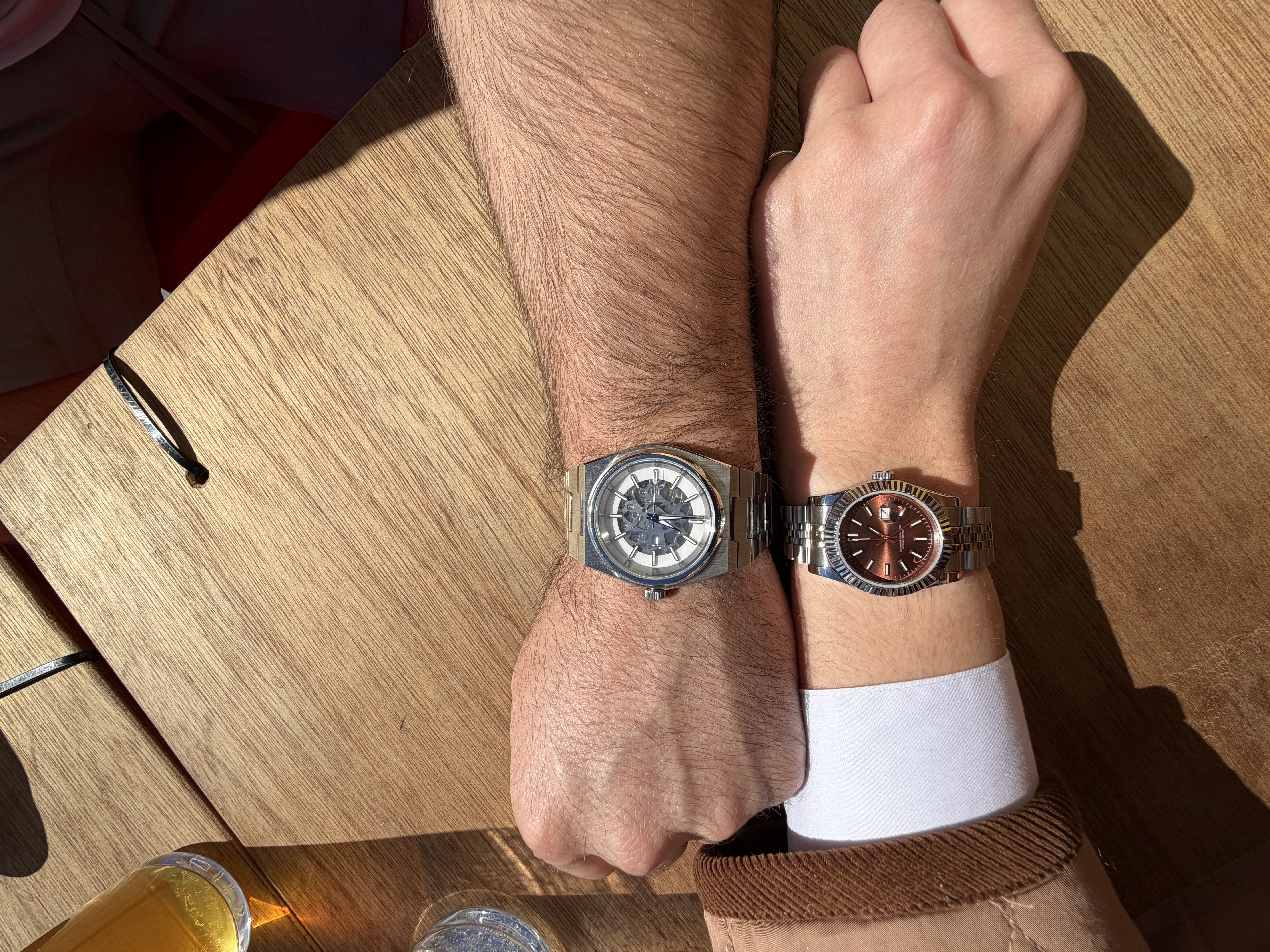
The barrier was the obvious one. Mechanical watches at the level she loved cost more than a car. The Tank that started it remains hers; everything else she might want — a chocolate-dial Datejust, a steel sports watch with an integrated bracelet, a skeleton dial that lets you watch the gear train tick — sits on the wrong side of a price tag that has never made much sense.
So she did what people who love things and can't afford them have always done: she got curious about how they were made. That curiosity led her into modding — the global, mostly online community that builds custom watches from current-production Seiko movements, aftermarket cases, dials, hands, and bracelets. The same components, the same hand-assembly, the same satisfaction of a properly regulated movement on the wrist. For a fraction of the cost. And, more importantly, made by you.
The kit
The break-point came when Ash's partner bought her an online watch kit — the kind shipped in a cardboard box with a movement, some parts, and a series of YouTube videos. It was meant to be a gift. It became a research project.
The kit assumed you already knew what you were doing. The videos moved fast through the parts that mattered and slow through the parts that didn't. They showed you what to do without ever pausing to explain why. Why does this hand have to be set in that order. Why does the movement need to be held this way and not that way. Why does it matter if the dial feet sit perfectly flush. There were no answers, only the next step.
She got the kit watch built eventually. It worked. It also taught her something the kit-makers didn't intend: that the gap between a kit and a class is everything. A kit gives you parts. A class gives you the reasoning that lets the parts make sense.
"The videos showed every step except the one that mattered — the why."
The friends round the table
What followed was quiet and informal. Ash had been around watch people in her family her whole life — they were watch-passionate, encouraging her to do something with what she'd taught herself. She started running small builds for friends at home. One at first. Then two. Then enough that the table at her place wasn't quite the right format anymore.
Word-of-mouth carried it for longer than you'd expect. People who had built one watch with Ash brought friends. Those friends brought more. By the time the question of "should we make this a real thing" came up, the answer had mostly already been decided by everyone around her.
Why a school, not a brand
The Modding Bench could have been a brand. Build the watches, put a logo on the dial, sell them online. It would have been easier. It also would have missed the point.
The point Ash kept coming back to was the one her own kit experience had taught her: people don't want to be sold a watch. They want to have made a watch. There is a specific kind of pride that only exists when the thing on your wrist is the thing your hands built that afternoon. That pride is not for sale. It can only be earned. The role of a school is to put the parts, the tools, and the instruction in front of a student so they can earn it themselves.
So that's what we became. A school. The bench is real, the tools are real, the parts library is real, and at the end of the afternoon there is a working mechanical watch on the student's wrist that wasn't there four hours earlier. We don't sell watches. We teach the assembly.
The female-led part isn't a marketing line
It's structural. Watch modding as it currently exists is built almost entirely around men's watch sizes. The cases, the dials, the bracelets — the standard sizing in the modding supply chain is forty millimetres and up, designed for a wider male wrist. If you're a woman who wants a 34mm or a 36mm case with a properly proportioned dial and a bracelet that doesn't swim on your arm, the options narrow rapidly. Most of them don't exist.
Ash works as a senior accountant and previously led a team in the Hunter Valley. She is used to being the only woman in the room. What she's not interested in is letting the modding world stay that way. Part of The Modding Bench's longer agenda is the design of cases and parts proportioned for female wrists — bringing the same range of choice to women that has always existed for men. We're working with suppliers in Switzerland, Japan, and Singapore on the first run. It will take time. It also matters.
So the "female-led" line on the homepage isn't a marketing decoration. It's a statement of who runs the workshop, whose taste shapes the parts library, and who is going to design the cases that finally make this craft properly accessible to half the people it has always quietly excluded.
What the bench looks like now
The Modding Bench operates from a shared workshop space in Surry Hills, Sydney, that we rent by the day. Classes run on Saturday and Sunday afternoons. Students arrive with no experience required and leave wearing a working mechanical watch they assembled from a parts library of cases, dials, hands, crowns, and bracelets. Across the launch inventory there are more than 1.7 million possible build combinations. No two watches built at the bench are alike.
We use Seiko-ecosystem automatic movements — the NH35, NH36, NH38, NH05, and NH70. They are the modding community's gold standard for a reason: robust, repairable, accurate enough, and made by Seiko, who have built reliable mechanical movements at scale longer than most luxury Swiss houses have existed. Every finished watch is tested on a timegrapher before the student leaves. We regulate it. We make sure it works. Then it goes home on their wrist.
Ash has personally assembled over fifty watches now. She has scratched dials and drowned movements in cases that promised water resistance and didn't deliver. The lessons are in everything she teaches.
That's how The Modding Bench started. A Cartier Tank, a frustrating kit, a kitchen table that ran out of room, and a workshop in Surry Hills that exists because somewhere along the way enough people had said could you teach me too that the only sensible answer was yes.
Build your own watch. Saturday and Sunday afternoons in Surry Hills, Sydney. Foundation build $595, Couples $1,095, Corporate tier from $535 per head for groups of six or more.
Reserve a bench