A workshop, not a kit.
Watch assembly kits are a perfectly fine product if you happen to know exactly what you're doing. For everybody else — which is most of us — they're a quiet exercise in frustration delivered in a cardboard box. This is the case for the workshop instead.
What a kit gets right
Let's begin with credit. The mail-order watch kit, in its modern form, is a thoughtful piece of product design. A movement, a case, a dial, hands, a strap, a small set of tools, all packed into a box that lands on your doorstep. A series of YouTube videos to follow. The promise is that for a few hundred dollars and an afternoon at the kitchen table, you can build your first watch.
For the right person, this works. The right person is someone who already has some manual dexterity, who is patient with their own mistakes, who can watch a video and follow it without needing to ask "but why", and who is willing to write off the cost if the first build doesn't survive. Kits are a fine entry point for that person. We're not the first to say so — there's a small but vocal community online who started with a kit, broke a few movements, and worked their way up.
But there's a category of would-be watch builder that the kit isn't designed for, and that category is most people.
What a kit gets wrong
The first problem with a kit is the one our founder ran into. The videos that come with most kits are designed to show you what to do, step by step. They are rarely designed to explain why. Why does this hand need to be set in this particular order? Why does the movement have to be held this way and not that way? Why does it matter that the dial feet sit perfectly flush against the movement plate? Why am I being told to use a small amount of pressure when intuitively more pressure should make this faster? These questions don't have answers in most kit videos. They have answers in a class.
The why matters because watch assembly is full of moments where the right action looks identical to the wrong action right up until something goes catastrophically wrong. Pressing a hand on with slightly too much force will work fine — until the moment it shears the cannon pinion and you have a watch that no longer keeps the right time. Mounting the dial without checking the feet alignment looks identical to mounting it correctly — until you close up the case and discover the dial is sitting at a fractional angle and there's nothing you can do about it without taking the whole thing apart. The kit videos don't warn you off these mistakes because they don't have time. The class can.
The second problem with a kit is that you get one set of parts. The kit gives you the watch the kit-maker decided you should build. Black dial, white indices, leather strap. Or some other singular combination. You can buy the kit, do the build, and end up with the watch the kit-maker would have shipped you fully assembled — minus the assembly process — for about the same money. There's a satisfaction in having done it yourself, but there's not much agency in what you did.
The third problem is solitary. Assembling a kit at your kitchen table is, by definition, a solo activity. You sit alone, with a pile of parts and a video on your laptop. You make a mistake. You either don't notice it, or you notice it and have no one to ask. You hit a step that doesn't make sense, and the video has moved on. The whole experience is a series of small private problems.
The kit videos show every step except the one that matters — the why.
What changes when you're in a room
Almost all of the above is solved by sitting at a bench with another person who has built watches before.
The first thing that changes is that the why becomes possible. When the instructor says "hold the movement this way, not that way", you can ask "but why does it matter?" — and you'll get an answer. You'll find out that the way you wanted to hold it puts pressure on the balance bridge, and that bridge protects a part called the hairspring that, if knocked, will cost you the rest of the build. Now you understand. Next time you pick up a movement, you'll hold it correctly without thinking. The why doesn't just teach you a fact. It rewires the way you handle the thing for the rest of your life as a watch builder.
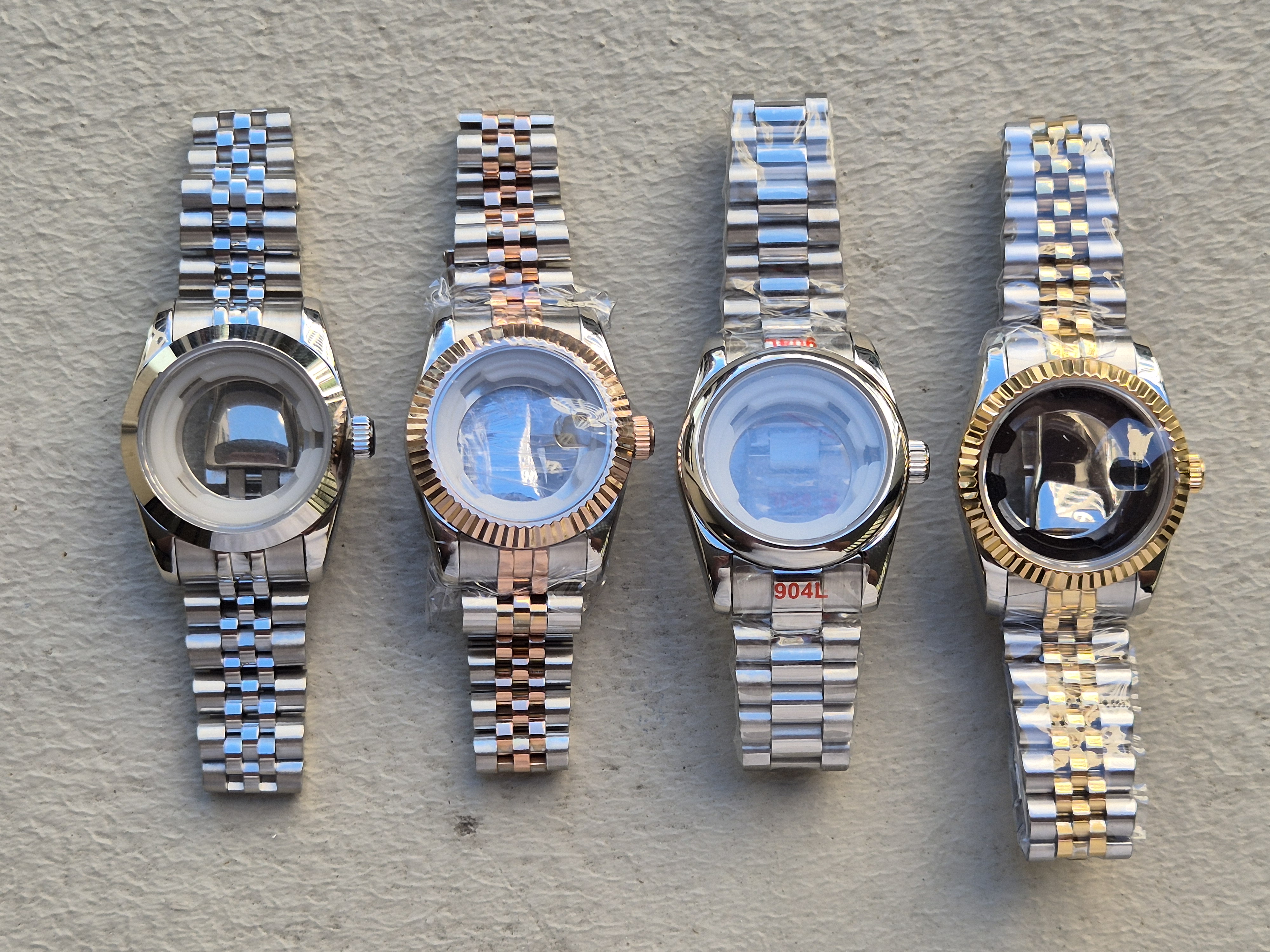
The second thing that changes is the parts library. The Modding Bench has more than 1.7 million possible build combinations across our launch inventory of cases, dials, hands, bezels, and bracelets. A student doesn't pick from one option — they walk in and pick from hundreds. Sunburst or matte. Salmon or chocolate or navy. Dauphine hands or syringe hands or plongeur. Steel Oyster bracelet or single-pass leather. The combinations are the personality. By the time a student finishes choosing, the watch they're about to build is already their watch in a way the kit watch never was.
The third thing that changes is the room. There are usually four or eight people building at the same time. Each at a different step. Each having their own small breakthroughs and frustrations. The instructor moves between benches answering questions, catching small mistakes before they become big ones, occasionally taking the tweezers from someone's hand and showing them the angle to come in from. The room hums. There is a particular quality of quiet focus you only get in rooms where everyone is trying to do something delicate.
The fourth thing — and this is the one no kit can replicate — is what happens at the end. The student takes their finished watch off the timegrapher, fits it onto the bracelet, and puts it on their wrist for the first time. There is always a moment. Sometimes a small audible reaction. Always a look. We watch for it every class. It's the difference between owning a watch and having made one. A kit can give you the second feeling. Only a class gives you the room of people who saw you do it.
The economic argument, for the people who care
Some people will assume a mail-order kit must be the cheaper option. The numbers say otherwise.
Start with the math. The most popular hobby-watch kits sold to Australian buyers — DIY Watch Club's Vintage Dive Kit, Modding Starter Combo, and Mosel Dress Kit — currently retail in the AU$320 to $455 range for the parts only. The toolkit you need to actually assemble one isn't included. DIY Watch Club's basic toolkit lists separately at $230 AUD plus shipping. That puts the all-in cost of a do-it-yourself first build at AU$550 to $685 before you've poured your first coffee — and you still do the work alone, in your kitchen, with YouTube as your only instructor.
The Foundation tier at the bench is $595 AUD. It includes the full parts library to choose from instead of the single combination the kit-maker decided to ship you. It includes the entire toolkit, professionally maintained, that we put back in the drawer after you leave. It includes 2 to 3 hours of one-on-one instruction. It includes a regulation pass on a timegrapher at the end so the watch leaves keeping good time. The watch on your wrist when you walk out is yours.
We are cheaper than the kit-plus-tools alternative. We just include the bit nobody else does — the room and the person who shows you how.
Here's what the $595 covers, item by item.
- The movement, dial, hands, case, crown, and bracelet you choose — same parts a kit would ship.
- Access to a parts library with hundreds of options instead of the one combination a kit forces.
- A full set of watchmaker's tools — tweezers, hand-presses, case-back openers, spring bar tools, lume torches, dust blowers, magnifying loupes — that we provide and you don't have to buy. A comparable starter toolkit retails for over $200 AUD on its own (DIY Watch Club's basic kit, the standard reference in the mail-order space, currently lists at $230 plus shipping).
- Three and a half to four hours of one-on-one instruction from someone who has assembled fifty-plus watches.
- One free rebuild attempt if something goes wrong during assembly — parts replacement at cost-price only.
- Timegrapher testing and hand regulation, so the watch leaves the bench keeping good time within a few seconds per day.
- The room. The other people in it. The instructor talking to them. The accumulated knowledge in the air.
If you remove the parts library, the tools, the instruction, the regulation, and the room, you have a kit. The kit gets you the parts. The class gets you the rest.
Most importantly, the class gets you a watch on your wrist at the end of the same afternoon. The kit-versus-class comparison sometimes presents the kit as the "real" learning experience because you do it alone. We respectfully disagree. Doing it alone, with a YouTube tuto