Setting the hands.
Of every step in a watch build, hand-setting is the one that breaks the most rebuilds. The hands themselves cost a few dollars each. The hour they steal from a class when something goes wrong is irreplaceable. This is why the step matters and how to do it properly.
What you're actually doing
The centre of every mechanical watch dial has three pinions stacked concentrically, each smaller than the last and rotating at a different speed. The hour pinion turns once every twelve hours. The minute pinion (set inside the hour pinion's bore) turns once every hour. The seconds pinion (set inside the minute pinion's bore) turns once every minute.
Three hands sit on these three pinions, in that order from bottom to top. The hour hand is the largest, with the widest bore — it grips the hour pinion. The minute hand is narrower, with a smaller bore, gripping the minute pinion that pokes up through the hour pinion's centre. The seconds hand is the narrowest, with the smallest bore, gripping the seconds pinion that pokes up through both of those.
On a Seiko NH35, the pinion sizes are:
Minute pinion — 0.90mm Ø
Seconds pinion — 0.20mm Ø
The corresponding hands have hand-fitting holes sized to match. Manufacturers cut the holes to a slight interference fit — slightly smaller than the pinion they grip — so the hands stay in place under their own friction. When you press a hand onto its pinion, you're forcing the soft brass hub of the hand to slide over the harder steel pinion until friction holds it.
Why the order matters
You fit the hour hand first, then the minute, then the seconds. The reason is mechanical: each subsequent hand has to clear the one beneath it. If you tried to fit the hour hand last, you'd have to slide it down past the minute hand and the seconds hand, both of which are already in place. The minute hand would block the hour hand's hub. You couldn't get it on.
The reverse approach — minute first, then hour — would mean reaching past the already-installed minute hand to set the hour hand below it. The minute hand would be in the way of your tweezers and the hand-press. It would also be at risk of being bent or knocked during the manoeuvre.
Hour first, then minute, then seconds is the only sequence that respects the physical stack.
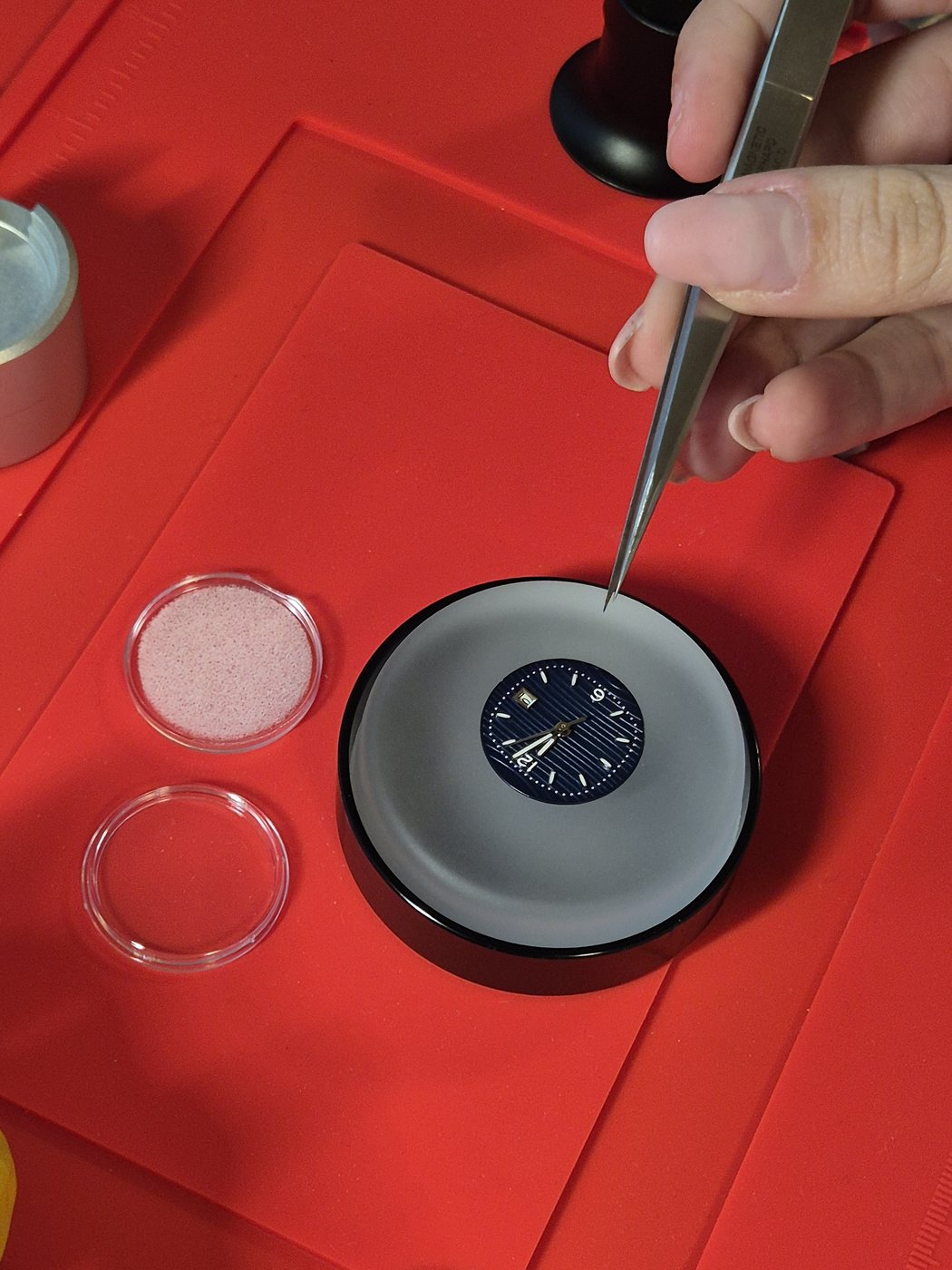
How the hands stack vertically
The three hands sit at different heights above the dial. The hour hand is lowest, almost flush against the dial. The minute hand sits a tiny fraction above it. The seconds hand sits a tiny fraction above the minute hand.
The gaps are small — on the order of tenths of a millimetre — but they matter. If two hands are too close, they rub against each other as time advances, dragging on the gear train and eventually stopping the watch. If they're too far apart, they look visually wrong from above (a seconds hand floating high above a flat dial reads as cheap-looking and ungainly).
What sets the spacing is how far down you press each hand onto its pinion. Press too hard on the hour hand and it'll sit flat on the dial — then the minute hand has nowhere to go but right next to it (collision risk). Press too softly on the hour hand and it'll sit higher than it should — then the minute hand sits even higher, and the whole stack looks tall and the seconds hand barely clears the case crystal.
The technique is consistent moderate pressure: press each hand just hard enough to feel a small click as it engages, then stop. The pinion is sized to do most of the work; the hand grips friction-tight without needing to be hammered down.
Why setting them at midnight matters
You set the hands at midnight — meaning, you orient them all to point at 12 when the watch's internal mechanism is at the moment of midnight. The reason is the date-change cycle.
On a date-equipped movement like the NH35, the date wheel underneath the dial advances by one click roughly every 24 hours. The mechanism that drives this — a small finger on the hour pinion's gear — engages with the date wheel's teeth for a brief window around midnight. During this window the date is "in transit" — partially advanced, but not yet locked into the new position.
If you set the hour hand to 12 when the watch is at a different internal time, you misalign the hour pinion's date-change finger from the date wheel. The result: the date changes at some other time of day. A watch where the date flips at 2 PM instead of midnight is annoying and obviously misset.
The technique to find midnight: insert the stem, pull to time-setting position, rotate the crown forward until you see the date wheel click over to a new number. The moment the click happens is midnight. Stop turning. Now position the hour hand and minute hand both pointing at 12.
Now the watch is aligned. When the hour hand returns to 12 in normal running (twelve hours later), it'll be noon. When it returns again (twelve hours after that), it'll be midnight again, and the date will click over precisely as the hour hand crosses the 12 marker. That's correct behaviour.
"The technique is consistent moderate pressure: press each hand just hard enough to feel a small click as it engages, then stop."
The tools
A hand-press is a small hand tool with interchangeable plungers, each plunger sized to fit a specific hand. The hour-hand plunger has a bore around 1.5mm; the minute-hand plunger around 0.9mm; the seconds-hand plunger around 0.2mm. The plunger fits over the hand-hub (the small tube on the hand's underside) and applies even downward force when you press the press's handle.
An alternative is hand-setting tweezers — a fine pair of tweezers with a stepped tip that can grip and press a hand without scratching it. This is what professional watchmakers often use, especially for the seconds hand where the press's plungers can be fiddly. It takes practice.
Avoid: trying to press a hand with your fingertip, a pencil, a wooden stick, or your tweezers directly without the right tip. All of these scratch the hand or push it on at an angle.
Common mistakes
Setting hands while the watch is running
If you don't remove the stem (or at least set the watch to a non-running position), the seconds hand can be ticking when you try to fit it. The result: the hand jumps as the seconds pinion catches it, and you end up with a bent hand or a hand that's seated at the wrong angle. Always set the watch to time-setting position (with the stem pulled out) before fitting hands.
Pressing on a tilt
If the hand-press isn't perpendicular to the dial when you press, the hand goes on at an angle. From above, the hand looks slightly tilted. Worse, the hand may rub against the next hand above or below. Always check the press is perfectly vertical before you commit to the press.
Setting the date at the wrong time
Some watches have a date-change "danger zone" — typically around 9pm to 3am on the crown — during which manually advancing the date by rotating the crown can damage the date-change gearing. The NH35 is relatively forgiving of this, but it's still better to set the date by rotating the crown forward through 12 hours of time-setting (which advances the date naturally) than by trying to jump the date directly.
Bending a hand
Brass hands bend easily. If you grip a hand with too much pressure in your tweezers, you bend it. If you press too hard with the hand-press, you can deform the hub. If you drop a hand on a hard surface, it lands at an angle and a tiny bend appears. Most of these bends can't be straightened — a bent hand needs to be replaced.
Mixing up the seconds hand
A common late-build mistake: realising the seconds hand is the wrong colour or style for your dial, only after you've already pressed it on. Removing a seconds hand is delicate — its 0.2mm pipe is fragile and the hand-press can't easily extract it. Test fit (place the hand without pressing) before you commit. Look at the colour, the style, the relative size against the minute hand. If anything's off, swap before pressing.
The aesthetic of well-set hands
A well-set hand stack is invisible. The hour, minute, and seconds hands sit at slightly different heights above the dial. Each one is parallel to the dial surface. The vertical clearance between them is just enough to prevent collision and no more. From any angle the watch looks correctly engineered — the hands appear to "live" at the dial level rather than floating above it.
A poorly-set hand stack is immediately obvious. The seconds hand floats. The minute hand tilts. The hour hand sits crooked. The whole watch reads as amateurish even if every other component is perfect.
This is why hand-setting is the step where the difference between a kit and a class becomes physical. Watching a video on your laptop while you set the hands on your kitchen table is the formula for a bent seconds hand at 7pm on a Sunday. Sitting at a bench with someone whose hands have done this several dozen times before — who watches your angle, says "hold the press straighter", and catches the small mistake before it costs you ninety minutes of recovery time — is the formula for getting it right the first time.
At the bench
We allow extra time at the hand-setting stage of every class. Half the questions we get are some version of "is this flat enough?" The honest answer: probably not yet, let me show you what flat looks like from the side. Hands-on instruction here is the difference between leaving with a watch that ticks beautifully and leaving with a watch that needs to be rebuilt.
If you do work alone with a kit, the single piece of advice we'd give is to set every hand twice. Set it once. Examine it from the side. Decide if it's right. Lift it off if it isn't. Re-seat. This sounds slow. It's faster than the rebuild.
Have us watch over your shoulder. Hand-setting is the part of every class where we sit closest. Foundation tier $595 — Surry Hills, Saturdays and Sundays.
Book a class