NH35 vs NH70: hands-on or skeleton?
The NH35 is what most modders build first — a robust three-hand workhorse hiding behind a solid dial. The NH70 is what they build second — a fully skeletonised showpiece where the gear train sits in plain view. Same family, completely different watches.
What each calibre is for
The NH35 is the workhorse of the Seiko modding world. We've covered it in detail in NH35 vs NH36 vs NH38, but the short version is that it's a three-hand automatic with date, designed for the OEM market, built like a tank, and supported by an aftermarket of thousands of compatible parts. Everyone's first build sits on one of these.
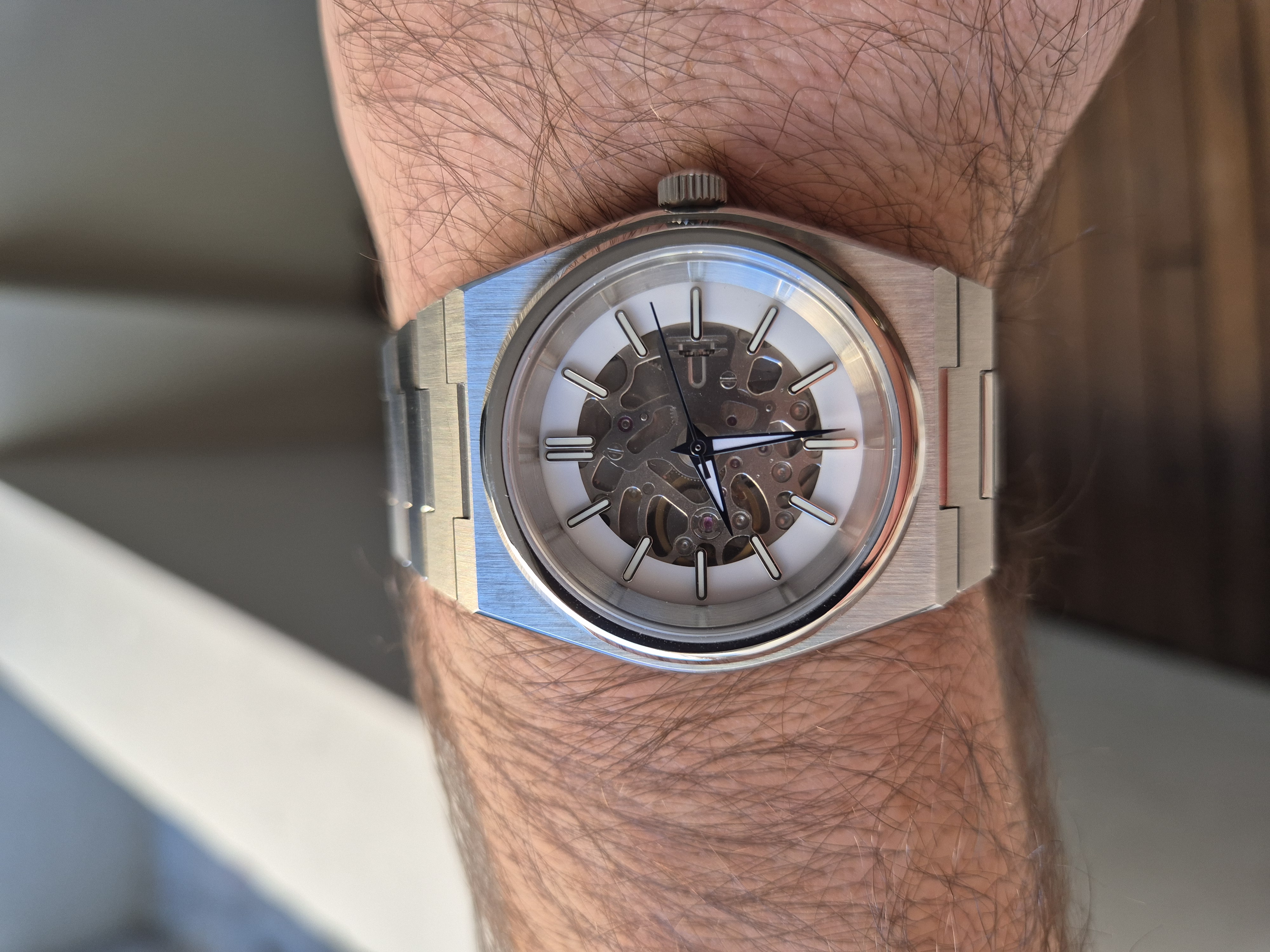
The NH70 is something else entirely. It's the same base movement family — Seiko's NH-series — but with the bridges and plates cut away so the gear train is visible. Pair it with a transparent or open dial and the whole watch becomes an exhibition piece on your wrist. You can watch the rotor swing, the balance wheel pulse, the escape wheel jump tooth-by-tooth in real time.
Most modders don't start with the NH70. Most modders eventually build one. That's because the NH35 teaches you the craft and the NH70 lets you show off what you learned.
Direct specifications comparison
| NH35 | NH70 | |
|---|---|---|
| Display | Solid dial, hands visible | Openworked dial, gear train visible |
| Date complication | Yes (3 o'clock) | No |
| Frequency | 21,600 BPH | 21,600 BPH |
| Reserve | ~41 hours | ~41 hours |
| Jewels | 24 | 22 |
| Diameter | 27.4mm | 27.4mm |
| Height | 5.32mm | 5.32mm |
| Dial diameter | 28.5mm with 3 feet | 28.5mm with 3 feet |
| Hand sizes | 1.50 / 0.90 / 0.20 mm | 1.50 / 0.90 / 0.20 mm |
| Hacking | Yes | Yes |
| Hand-winding | Yes | Yes |
| Build difficulty | Beginner | Intermediate |
| Aftermarket support | Vast | Growing but smaller |
You'll notice how much is identical. The NH70 is the NH35's architecture with the bridges and date complication cut away. The 22-jewel count (versus 24 in the NH35) reflects the absence of the date-wheel mechanism — those jewels weren't doing anything in a skeleton calibre, so they came out.
The visual difference is the whole point
A solid-dial NH35 build hides everything that makes a mechanical watch interesting. The rotor, the gear train, the balance wheel, the escapement — all of it lives behind a painted disc. You hear the ticking through the case but you never see the parts that produce it.
An NH70 build does the opposite. The dial is cut away in a wide central window. The bridges are openworked. The rotor on the back is visible if you also fit a sapphire caseback (which most modders do for an NH70 — there's no point hiding the back half if you've revealed the front). You spend ten percent of your wrist-time looking at the watch and ninety percent of it admiring what's underneath.
The aesthetic this calibre lives for is the Tissot PRX skeleton, the Patek Calatrava Squelette, the Audemars Piguet Royal Oak Skeleton — fully exhibitionist watches where the architecture is the design. At Seiko-modding prices, the NH70 is the most cost-effective entry point to that look on the market.
"A solid dial hides everything that makes a mechanical watch interesting. The NH70 hides nothing."
How they behave on the bench
The NH35 is the more forgiving build. The dial is solid, so small handling marks or fingerprints on the movement underneath disappear once the dial is fitted. The hand-setting stage is still precision-critical but the visual end-state is what most people picture when they imagine a mechanical watch.
The NH70 demands more care for two reasons. The first is that nothing is hidden — every fingerprint, every speck of dust, every scratch on the rotor or the bridges is visible in the finished watch. We use gloves more aggressively on NH70 builds and we clean the movement with compressed air at least twice during the build, not just once at the end.
The second is the hand-setting. On an NH35 the hands sit just above a solid dial. On an NH70 the hands span an open void with the gear train visible underneath. The depth becomes part of the visual composition; hands that are seated slightly too high or slightly off-axis look more wrong than they would on a solid dial because there's nothing visually grounding them. Setting hands on an NH70 takes longer and rewards taking longer.
This is why we tier the NH70 into our Premium class ($595) rather than the Foundation. The build takes 3 hours (may run an hour over) instead of 2 to 3, and the precision demands sit a step above. We don't generally recommend starting with one.
What they cost to build
The NH70 movement itself costs roughly twenty to forty dollars more than an NH35 at our supplier prices. The cases designed for it are more specialised (they need to be designed for the openworked dial and the sapphire caseback) and run slightly more expensive in the modding aftermarket. The dials — usually a clear acrylic ring with painted hour markers and an open centre — sit in the same price band as a solid dial.
At the bench, the only price difference between an NH35-based Foundation build and an NH70-based Premium build is the tier price (both Foundation at $595, Premium only for exclusive cases at $795). That hundred-dollar gap covers the extra build time, the more selective parts library for skeleton-compatible cases, and the additional regulation care a skeleton movement deserves.
Which one's right for you
If this is your first watch build
NH35. You'll learn the craft on a more forgiving platform, end up with a watch you'll wear daily, and have a foundation for moving to the NH70 next.
If you already own and have built a watch before
NH70. You've earned it. This is the build people come back for as their second or third project. The wow-factor of seeing the gear train moving on your wrist is the reason people fall further into the hobby.
If you want a daily-wearable watch that's also a conversation piece
NH70. Every person who shakes your hand or glances at your wrist will ask about it. We've never had a customer with a skeletonised build report otherwise.
If you want a tool watch you can knock around
NH35. Skeleton dials hide nothing, including the marks left by hard daily wear. A diver-style NH35 build in a brushed case is the watch you wear to the beach without thinking about it. An NH70 demands more careful handling.
If you want to gift a partner or family member their first mechanical watch
NH35. Easier to wear daily, less fragile, more parts to pick from. The NH70 is what they'll build next when they get hooked.
Both at the bench
At The Modding Bench we run both. The NH35, NH36, and NH38 sit in the Foundation tier ($595 per person). The NH05 (with bezel) and the NH70 (skeleton) sit in the Premium tier ($795 per person). A student building their first watch with us almost always starts on an NH35; a student returning for a second class about half the time picks the NH70.
Couples often pair them — one of you builds an NH35, the other builds an NH70, and the contrast on the wrist when you walk out together is genuinely lovely. You can do that side-by-side at the bench in our Couples tier ($1,095 for two builds).
The honest verdict
The NH35 is the watch you should build first. The NH70 is the watch you should build next. They are not rivals. They are sequential.
Pick the NH35 if you want to learn the craft and end up wearing something every day. Pick the NH70 if you've already done that, or if you specifically want a skeleton from the start and you're willing to spend the extra time the build asks for. Either way you end the day with a working mechanical watch on your wrist that you assembled with your own hands. That part is the same.
Build both — eventually. Foundation tier ($595) builds use NH35, NH36, or NH38. Premium tier ($795) builds use NH05 or NH70. Surry Hills, Sydney. Saturdays and Sundays.
Reserve a bench