How a mechanical watch actually works.
A mechanical watch is a tiny engine. It stores energy in a coiled spring, releases that energy in carefully metered pulses, and uses those pulses to drive a set of hands across a dial. This is the plain-English explanation of how that works — written for someone who has never opened a watch.
Start with the problem the watch is solving
A watch has one job: turn an hour hand once every twelve hours, a minute hand once every hour, and a second hand once every minute, with enough accuracy that the time it shows is useful. To do this without a battery — purely from the physics of springs and gears and the small movements of a human wrist — is harder than it sounds. The whole architecture of a mechanical watch exists to solve that problem.
There are five things going on inside the case. Once you understand all five, you understand watches.
- The mainspring — the energy source. A coiled steel ribbon that wants to unwind.
- The gear train — the transmission. A series of gears that steps the mainspring's slow unwinding into the speeds the hour, minute, and second hands need.
- The escapement — the brake. The most ingenious component. A small mechanism that releases the gear train one tiny step at a time.
- The balance wheel — the metronome. A weighted wheel that swings back and forth at a precise frequency, telling the escapement when to release.
- The rotor (in automatic watches) — the winder. A weighted disc that spins as you move your wrist, slowly winding the mainspring back up.
Take those five and the rest of the watch is plumbing. Let's go through them one at a time.
1. The mainspring — where the energy comes from
The mainspring is a long, thin ribbon of high-tensile steel, coiled inside a drum called the barrel. When you wind a watch — either with the crown by hand, or automatically through the rotor — you are tightening that spring. The spring wants to uncoil. It cannot uncoil quickly, because there is a small lid on the barrel and an axle through the middle. So instead it slowly, persistently, applies torque to a small gear sitting on the outside of the barrel.
That torque is the only energy the watch will use. Everything that follows is the question of how to extract it slowly and predictably enough to tell time.
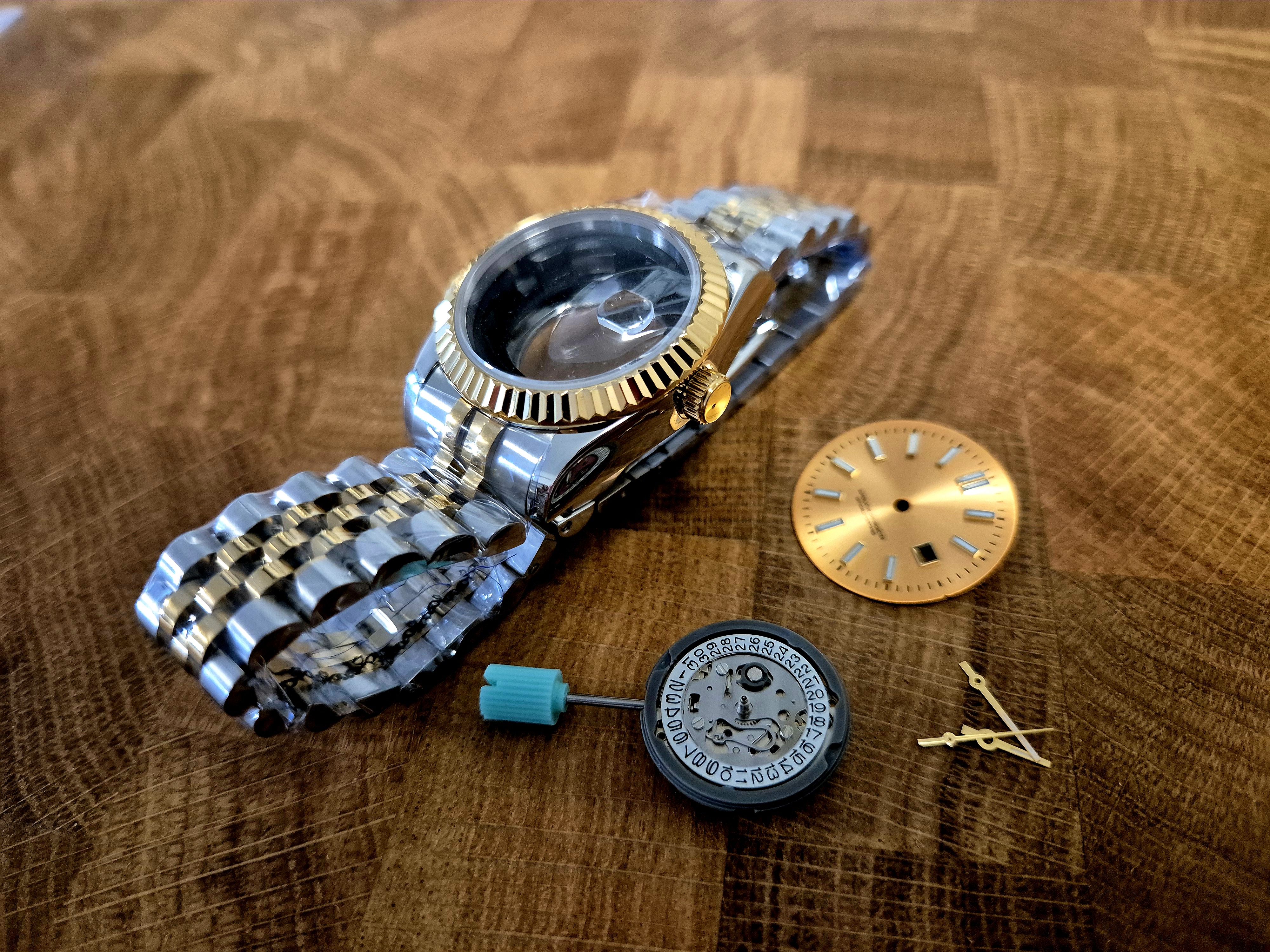
A typical modern mainspring stores enough energy to run the watch for roughly 38 to 70 hours, depending on the calibre. Seiko's NH35 movement, which we use frequently at the bench, holds approximately 41 hours of reserve from fully wound. Higher-end movements run longer because their springs are longer, the barrels are bigger, or both.
2. The gear train — the transmission
If you let the mainspring uncoil freely, it would do so in a few seconds and you'd hear it as a whir. Useless for telling the time. The gear train slows it down.
The barrel turns a series of progressively smaller gears, each one spinning faster than the last. Think of a bicycle in low gear — one slow turn of the pedals becomes several quick turns of the rear wheel. A watch's gear train does the same in reverse: many slow turns of the barrel become very fast turns of a tiny gear at the far end of the chain.
By the time the energy reaches the last gear in this train — called the escape wheel — it is spinning fast, with very little torque. That fast-spinning, low-torque output is exactly what the next component needs.
Along the way, three of those gears have an extra job: they carry the hands. One drives the seconds. One drives the minutes. One drives the hours. These are arranged concentrically — all three turning around the same central axis — so the hands can sit on top of each other on the dial.
3. The escapement — the genius of the whole thing
The escapement is where mechanical watchmaking earns its reputation. Everything else in the watch is a problem ordinary engineering can solve. The escapement is the part that took centuries to perfect.
Here is the problem: the gear train wants to unwind continuously. Time happens discretely — you cannot measure it without ticking. The escapement is the mechanism that converts continuous motion into a tick.
It works like this. The fast-spinning escape wheel at the end of the gear train has a set of curved teeth around its edge. Above it sits a small Y-shaped component called the pallet fork, which has a tiny jewelled tip on each arm.
As the escape wheel tries to turn, one of the pallet fork's jewelled tips catches a tooth and holds the wheel in place. Briefly, the gear train is locked. Nothing moves. Then the pallet fork rocks to one side — released by the balance wheel, which we'll get to in a moment — letting that tooth slip past. The wheel jumps forward a fraction of a turn before the other pallet tip catches the next tooth and locks it again.
That rhythmic catch-release-catch-release is the ticking sound. Every release lets the gear train, and therefore the hands, advance by a precise tiny amount. The watch is not telling time smoothly. It is telling time in five or six discrete jumps per second.
4. The balance wheel — the metronome
The escapement decides when to release the gear train, but it doesn't decide on its own. It is told when, by the balance wheel.
The balance wheel is a small weighted wheel with a fine spiral spring at its centre called the hairspring. The hairspring is tensioned so the balance wheel naturally oscillates back and forth at a fixed frequency — the same way a pendulum swings, but at a much higher speed and inside a wristwatch instead of a longcase clock.
Every half-oscillation, the balance wheel briefly nudges the pallet fork. That nudge unlocks the escapement, the gear train jumps forward one tooth, and the balance wheel continues its swing. The pattern is metronomic. The frequency of the balance wheel sets the rate of the watch.
Modern movements are described by their oscillation rate — usually in beats per hour, or BPH.
= 6 oscillations per second
= the ticking pattern you can hear if you hold the watch to your ear
Some Swiss movements run at 28,800 BPH (8 per second). Some higher-grade chronometers run at 36,000 BPH (10 per second). Faster oscillation is harder to engineer and shortens lubrication life — but it makes the watch more resistant to shock and small wrist movements, because each beat is shorter and any disturbance affects a smaller percentage of it. There is no universally correct rate, only trade-offs.
The crucial point: if the balance wheel oscillates at exactly 21,600 BPH, the watch keeps perfect time. If it runs slightly slower, the watch loses time. Slightly faster, it gains. Regulating a watch — what we do on a timegrapher at the end of every class — means making tiny adjustments to the effective length of the hairspring, which tunes the balance wheel's frequency. A well-regulated NH35 settles within plus or minus 10 seconds per day. A poorly regulated one can drift twenty or thirty.
5. The rotor — automatic winding
A purely manual watch needs to be wound by hand each day by turning the crown. An automatic watch — what we build at the bench — adds a fifth component to take care of this for you.
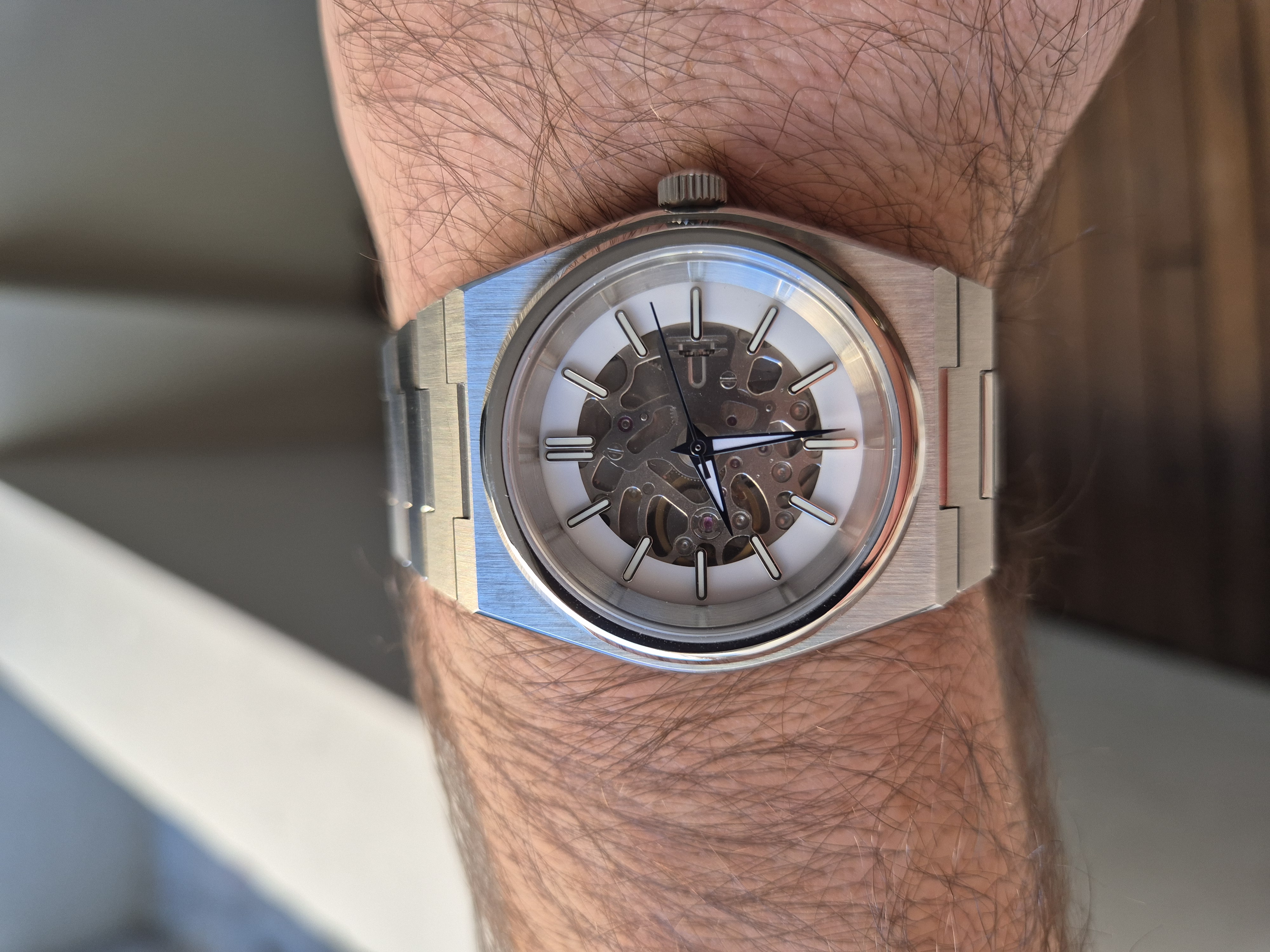
On the back of the movement, a semicircular weighted disc swings freely on a central pivot. This is the rotor. As your wrist moves through the day, the rotor swings on its pivot. Gravity keeps it weighted to one side; your wrist movement keeps shifting which side that is. The rotor's swinging motion is geared back to the mainspring barrel. Every swing winds the spring a tiny amount.
Over the course of an average day on the wrist, the rotor winds the mainspring more than enough to replace what the gear train consumes. The watch maintains its full reserve indefinitely as long as you wear it. Take it off for a few days and it will eventually run out of reserve and stop. Pick it up, give the crown twenty or thirty turns to wake it, and you're back in business.
You can hear the rotor working if you hold an automatic watch to your ear and tilt it side to side — there is a soft whir as it swings.
How it all moves together
Put it together and a complete cycle looks like this:
- Energy enters the mainspring (either through manual winding or the rotor).
- The mainspring pushes torque through the gear train, which steps it up into high-speed, low-torque rotation at the escape wheel.
- The escape wheel is held in place by the pallet fork.
- The balance wheel oscillates at a precise frequency, nudging the pallet fork to release the escape wheel once per half-oscillation.
- The escape wheel advances one tooth — the tick. The gear train moves forward fractionally. The hands advance.
- The pallet fork catches the next tooth. The watch is locked again. The balance wheel swings back. The pattern repeats — six times every second, all day, for as long as the spring has tension.
Why this is harder than it looks
The components above are simple in principle. They are extraordinarily hard to make work consistently.
The balance wheel must oscillate at the same frequency whether the watch is hot or cold, flat on a desk or vertical on a wrist, fully wound or near the end of its reserve. Temperature changes the elasticity of the hairspring, which changes the rate. Gravity affects the balance differently in different positions. The mainspring puts out more torque when fully wound than when nearly run down. Each of these is a problem watchmakers have spent centuries chasing — temperature-compensated alloys for the hairspring, position-adjusted regulation, mainsprings designed to deliver flatter torque curves.
A modern Seiko NH35 keeps time within roughly plus or minus 15 seconds per day from the factory and can be regulated to within plus or minus 5 with care. That accuracy comes from over a century of incremental refinements to every component above. It is taken for granted now. It shouldn't be.
How this compares to a quartz watch
A quartz watch solves the same problem differently. Instead of a balance wheel oscillating at 6 Hz from a hairspring, a quartz watch uses an electrically excited quartz crystal that vibrates at exactly 32,768 Hz — over five thousand times faster, and almost completely insulated from temperature, position, and shock. A small circuit divides those vibrations down to one pulse per second and uses that to step a small motor that turns the hands.
Quartz is more accurate than mechanical by an enormous margin. A good quartz watch will keep time to within plus or minus 15 seconds per year. A good mechanical one will drift that much in a day. The reason mechanical watches still matter has nothing to do with accuracy and everything to do with the fact that a quartz watch is a small computer with hands, and a mechanical watch is a hand-assembled engine.
That difference is what brings most people to the bench in the first place. The watch you wear after the class is not the most accurate watch you could buy. It is, however, the only watch on your wrist that you can credibly claim to understand.
What we teach at the bench
At The Modding Bench, every class begins by laying out a bare Seiko movement on the mat in front of the student. Before any assembly, we walk through the components above — barrel, gear train, escape wheel, pallet fork, balance wheel — so the student can see them and understand what they are about to do. We do not assume prior knowledge. We do assume curiosity.
Over the following 3.5 to 5 hours, the student assembles the watch with their own hands: fitting the dial, setting the hour and minute and second hands, casing the movement, attaching the crown, fitting the bracelet. At the end, we put the finished watch on a timegrapher — a piece of test equipment that listens to the ticking pattern of the escapement and reports the rate to the nearest second per day. We regulate the watch by hand until it sits within the tolerance we are aiming for. Then the student takes it home, on their wrist, working.
This is the article we recommend reading first if you have never thought about how a watch works. It will make the next two — on the parts of a watch and on the Seiko NH-movement family — read like familiar ground.
Build the watch yourself. Four