Why we use Seiko movements instead of Swiss ETA.
The watch world has spent a hundred years training people to associate "Swiss" with "good." When you start assembling watches at the bench, you stop caring about prestige and start caring about whether the movement can actually be worked on. That changes the conversation entirely.
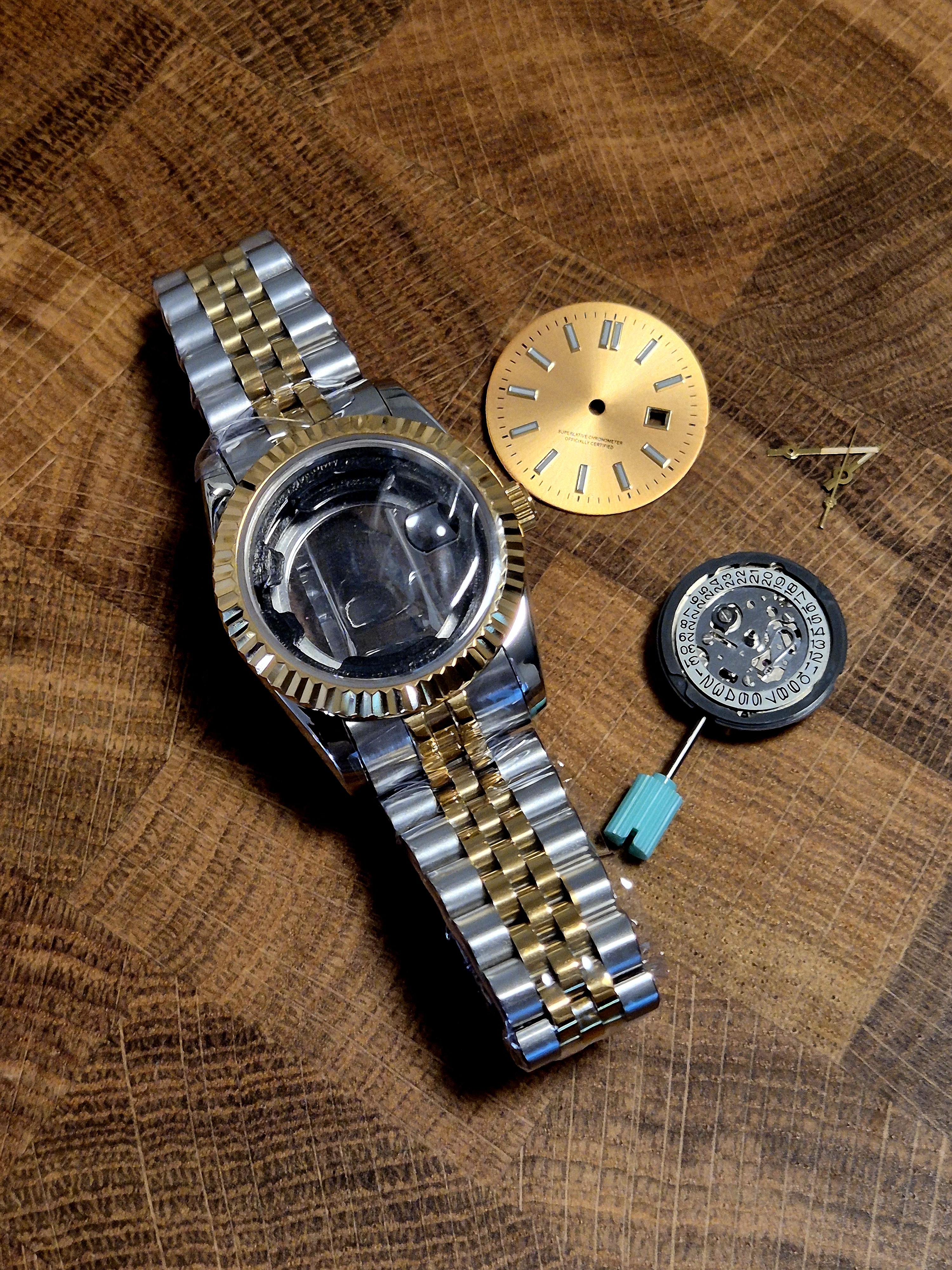
This is a question we get asked at almost every class. Why are we using Seiko movements? Why not the Swiss ETA 2824, the calibre everyone has heard of, the one that lives inside half the entry-level Swiss watches sold in the last forty years? The short answer is that ETA is a fine movement but it is the wrong choice for what we do. The long answer is below. Strap in.
What we use, in case you've just landed here
At The Modding Bench we use the Seiko NH-series automatic movements. There are five of them in our parts library, all designed and manufactured by Seiko Instruments in Japan:
NH36 — adds day-date. Slightly more complex dial work.
NH38 — date-less. Cleaner dials, especially good for skeletonised builds.
NH05 — slimmer cousin of the NH35, common in diver-style builds with rotating bezels.
NH70 — fully skeletonised dial; the gear train is visible. The showpiece.
All five: 21,600 BPH · 41-hour reserve · hackable · hand-winding · 24 jewels (NH35/36/38), 21 jewels (NH05), or 22 jewels (NH70).
These are not boutique movements. Seiko produces them at scale for use in the entry-level Seiko 5 line and as standalone movements sold to other watchmakers and modders. The NH-series is, by some margin, the most-modded movement family in the world. The reason is simple: it is what you'd choose if you wanted to learn watchmaking on a bench at home and you weren't being driven by marketing.
The case against Swiss ETA
Let's begin with what's wrong with the obvious alternative.
The ETA 2824 is the workhorse Swiss automatic movement. Designed in 1972, manufactured by ETA SA (a subsidiary of the Swatch Group), it sits inside Hamilton, Tissot, Mido, Longines, and dozens of microbrand watches. It is well-engineered, properly proportioned, and Swiss-stamped. By any measure it is a competent calibre.
It is also, in practice, the wrong movement to put in a teaching workshop. There are three reasons.
1. ETA stopped selling to outsiders
In 2011, the Swiss Federal Tribunal allowed ETA to begin restricting sales of its movements to non-Swatch-Group customers. The intent was to push smaller Swiss brands to develop their own movements; the effect, for the rest of the watch world, was to make ETA movements progressively harder and more expensive to source. A modder ordering twenty NH35 movements from a parts supplier today will pay roughly fifteen percent of what they'd pay for twenty ETA 2824s — and they can actually get the NH35 in stock.
For a workshop running classes every weekend, supply matters more than provenance. We need to know that the movement on a student's mat today will still be available next month at the same price. Seiko has spent forty years scaling up production of the NH-series to meet exactly that need. Swatch Group has spent fifteen years pulling ETA back from it.
2. ETA parts are harder to come by
This compounds the first problem. If a student damages a stem on an ETA 2824 during assembly — which happens, because student hands are still learning — the replacement is a small odyssey through Swiss parts catalogues, often through grey-market vendors, with lead times measured in weeks. The equivalent NH35 stem ships in two days from a Japanese or Singaporean wholesaler. We test our supply chain by breaking things on purpose. The NH-series wins this test by an embarrassing margin.
The broader modding ecosystem reinforces this. There are now thousands of aftermarket dials, cases, hands, bezels, and crowns designed specifically to fit Seiko NH movements. The total cottage industry around the NH35 alone is larger than the total cottage industry around the ETA 2824. If we put a Swiss movement on the bench, we would also be cutting the student's library of dial and case options to maybe ten percent of what we currently offer. That ratio matters more than the Swiss-vs-Japanese distinction the watch press obsesses about.
3. The accuracy gap doesn't matter at this price point
A factory-fresh ETA 2824-2 in standard grade is rated to keep time within roughly plus or minus 12 seconds per day. A factory-fresh NH35 is rated within plus or minus 15. The Swiss movement is, on paper, three seconds per day more accurate.
In practice, after regulation on a timegrapher — which we do for every watch that leaves the bench — both movements settle within a comparable range. A regulated NH35 sits within plus or minus 5 seconds per day. A regulated ETA in the same grade sits within plus or minus 3 to 5. The gap closes to near-nothing for the small additional cost of a ten-minute regulation session at the end of the build.
The "Swiss accuracy advantage" people pay for at this price level is real but it is also tiny. It is dwarfed by the difference a single regulation pass makes. It is dwarfed twenty times over by the difference a quartz movement makes (which is more accurate than both by orders of magnitude — but no one buys a mechanical watch for accuracy, so this comparison misses the point in a different direction).
"Swiss accuracy advantage" is real and tiny. It is dwarfed by a single regulation pass on the bench.
What Seiko's NH-series does better
Hackable seconds
"Hacking" means the second hand stops when you pull the crown to the time-setting position. This lets you sync a watch precisely to a reference clock. The NH35 onwards has hacking seconds standard. The cheaper Seiko 7S26 — the older generation it replaced — did not. The hacking second hand seems like a small thing until you've built a watch without it.
Manual winding
An automatic watch winds itself from wrist motion, but if it has been off your wrist for several days the reserve will be exhausted and you'll need to either shake it or wind it manually to get the seconds hand moving again. The NH35 family supports manual winding through the crown. The 7S26 did not — you had to actually shake the watch to wake it, which is irritating in practice. The newer NH-series fixes this.
Robust under student hands
The NH-series is built like an industrial movement, not a watch movement. The components are robust to a degree the ETA isn't quite. Dial feet sit in deeper holes. The day-date wheel is positioned to forgive small misalignments. The stem and crown geometry tolerates more cycles of insertion and removal. These are forgiving design choices that matter when the hands setting the dial belong to a student on their first build.
We have student-tested every part of these movements harder than any reasonable owner ever would. The recovery rate from minor mistakes is high. This is the practical, unglamorous reality of running a teaching workshop: the movement that lets you recover from beginner errors is the right movement. It happens to be Japanese.
Parts compatibility with the wider Seiko ecosystem
The NH35's dimensions are nearly identical to Seiko's own 4R36 and 6R15 calibres used in higher-end Seiko watches. This means the dial and hand options that work with the NH-series also work with vintage Seiko cases, current Seiko 5 cases, and many aftermarket cases designed for either. The cross-compatibility is enormous. We can take a 1970s Seiko diver case, drop an NH35 movement into it, set a modern dial on top, and the whole thing comes together like it was designed for each other. ETA has nothing equivalent.
Where Swiss does still have the edge
We are not here to trash ETA. There are things Swiss movements do better, and we will tell a student honestly about each one if they ask.
Finishing. A high-grade ETA 2824 (the "top" or "chronometer" grade) has more refined finishing on the visible movement parts — anglage on the bridges, perlage on the rotor, blued screws. If you are buying a watch with a display caseback to admire the movement, a properly finished Swiss calibre wins on aesthetics. Most NH-series movements are industrially finished — they look like the working tools they are.
Higher-end variants. ETA's calibres climb a long ladder. Above the base 2824 sit the 2892 (slimmer), the 2895 (sub-second), the 7750 (chronograph), and various COSC-certified chronometer grades. Seiko has its own ladder — the 4R, 6R, 8L, 9S series — but the very top of that ladder is reserved for Grand Seiko's own brand and not available to modders. If your end goal is a chronograph or a sub-seconds dial, ETA still has more accessible options.
Heritage. Swiss movements carry more than a century of watchmaking lineage. Japanese movements carry seventy years of mass-production engineering brilliance, which is not the same kind of romance. Some people care about the romance. We respect it. We just don't think the romance should win in a teaching workshop where the goal is for someone to leave with a working watch they built.
What you actually get with a Seiko NH movement
Putting all of the above into one picture: a student building on an NH35 at the bench is working with a movement that
- is in stock, in volume, at every parts supplier we work with;
- has an aftermarket of dials, hands, cases, bracelets, and bezels that runs into the tens of thousands of combinations;
- is forgiving of beginner mistakes in a way Swiss movements designed for closed-environment factory assembly aren't;
- can be regulated to within a few seconds a day on a standard timegrapher;
- has hacking seconds and manual winding (the table-stakes features the older 7S26 didn't);
- shares dimensions with Seiko's higher-end calibres, so cases and dials cross-compatible across generations;
- costs less than a fifth of the equivalent ETA movement, leaving more of the student's build budget for cases, dials, hands, and bracelets — the parts they'll actually see.
That last point is the one we care most about. A watch is, to look at, mostly its dial and its case and its bracelet. The movement is invisible behind a closed caseback in ninety percent of finished builds. Putting more of the build budget into the visible parts is what gives the watch its personality. Putting more of it into a Swiss movement that the wearer will never see again is what gives the build its prestige. Different goals. We have chosen the first.
The honest verdict
If you want to spend a lot of money on a beautifully finished movement that lives behind a sapphire display caseback and you can show your watch friends, Swiss is still the answer. If you want to assemble a working mechanical watch with your own hands, in an afternoon, that will keep time within a few seconds per day for decades — and you'd like to spend the rest of your budget on a watch you'll actually be looking at — Japanese is the answer.
Our bench is set up for the second goal. That's why we use Seiko.
Build a Seiko NH35 watch with your own hands. Surry Hills, Sydney. Foundation tier $595 — includes the movement, case, dial, hands, bracelet, all tools, instruction, and the watch on your wrist when you walk out.
Reserve a bench <