NH35 vs NH36 vs NH38: which Seiko movement should you build first?
The three workhorse calibres at the bottom of the Seiko NH family are nearly identical engines wearing slightly different jackets. Choosing between them is mostly a question of how you want the dial to read at three o'clock. Here's the proper comparison.
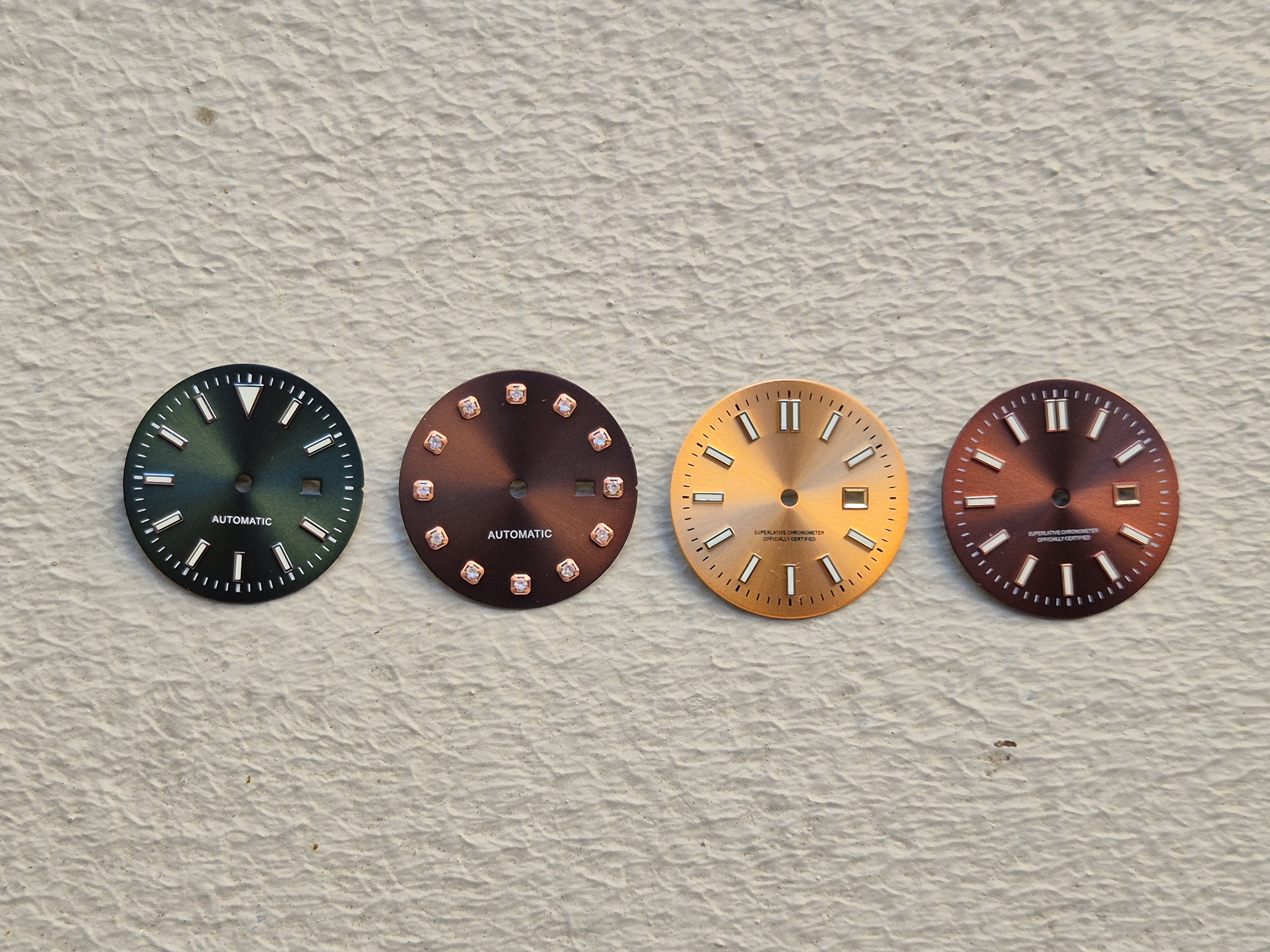
The short version
If you don't want to read the rest of this article, the answer is almost always the NH35. It's the modding world's default for a reason. The NH36 is the right choice if you specifically want a day-and-date dial (think Rolex Datejust with the day window at twelve). The NH38 is the right choice if you want a clean dial with no date window at all — most commonly because you're going skeletonised or because your aesthetic is dress-watch minimal.
That's the whole decision tree. Everything below is detail.
What the three movements actually are
The Seiko NH35, NH36, and NH38 are sister calibres in Seiko Instruments' NH-series — a family of automatic mechanical movements designed for OEM use in mid-tier watches and sold openly to the modding aftermarket. They were introduced in the mid-2010s as successors to the older 7S26 family, the calibre that powered the original Seiko 5 and SKX lines for decades.
All three share the same base architecture:
Reserve — approximately 41 hours fully wound
Jewels — 24
Diameter — 27.4mm (Ø)
Height — 5.32mm
Dial diameter — 28.5mm with three dial feet
Winding — automatic (hand-winding supported)
Hacking seconds — yes
Manufacturer — Seiko Instruments, Japan
The internal architecture, the gear train, the escapement, the balance wheel — all identical across the three. The differences are entirely in the date complication layered on top.
The differences, one at a time
NH35 — date only
The NH35 is the calibre that wears the simplest dial. A single date window, usually at three o'clock (sometimes six, depending on the dial). Time-setting works the standard way: pull the crown out to the second position to set the date, pull it to the third position to set the time. There is no day-of-week wheel anywhere in the movement.
The date window on an NH35 sits between the indices on most dials. Some modders consider this a flaw and prefer a no-date dial; we consider it the right answer for ninety percent of builds because the date is the single most useful complication on a mechanical watch. You will glance at it every day.
The NH35 is also, by a country mile, the most well-supported movement in the modding aftermarket. Almost every dial sold for the NH family is cut for the NH35 first and the others as variants.
NH36 — day-date
The NH36 adds a small day-of-the-week wheel that shows through a second window at twelve o'clock on most dials (sometimes at three, paired horizontally with the date). The day wheel rotates once per week. Some come in a single language, others come in a two-language ring (English on one side, Spanish/French/Arabic/Kanji on the other) — Seiko historically loved the dual-language wheel.
Time-setting is the same as the NH35, with the added wrinkle that the day wheel advances automatically each day. Like the date wheel, the day wheel ticks over around midnight (you'll see it crawl across an hour or so on either side of twelve as the gearing pushes it forward). Avoid setting the time backwards through midnight or you risk the date-change gearing — this is true of all three calibres, but more annoying on the NH36 because you also have to reset the day if you mess it up.
The aesthetic this calibre lives for is the Rolex Day-Date (the "President"), the Tudor Date+Day, or the vintage Seiko 5 Sports look. A day window at twelve with date at three. If that's the dial you're chasing, the NH36 is the only option — neither the NH35 nor any of its other relatives gives you that arrangement.
NH38 — no date
The NH38 strips the date complication out entirely. No date window. No date wheel inside the movement. The dial sits clean across all twelve positions, with nothing breaking the symmetry between three and four o'clock.
This matters in two situations. The first is a skeleton or semi-skeleton dial, where the date wheel would intrude on the visual openness of seeing the gear train below. The second is any kind of formal or dress dial — a minimalist three-hand watch with sword or dauphine hands and no clutter feels more deliberate without the date breaking the silence.
The NH38 is also slightly lighter on the eye for builds that lean into vintage references. Almost no watch made before 1956 had a date complication; if you're chasing pre-1960 styling, the NH38 is the calibre that gets out of your way.
How they behave on the bench
Assembly is functionally identical across all three. The dial feet, dial diameter, hand sizes, case fit, stem diameter, and crown geometry are interchangeable. A case designed for the NH35 fits the NH36 and NH38 without modification. A set of hands fitted for the NH35 fits the NH36 and NH38. A dial designed for the NH35 will fit the NH38 (provided you don't mind looking at a date window with nothing in it — most NH38-specific dials have no date cutout).
The NH36 introduces one extra consideration during dial fitting: you have to align the day wheel underneath the day window correctly before you secure the dial. Get this wrong and the day wheel shows you a wedge of two letters instead of a single complete word. We catch this for students in the class. Working alone, with a YouTube video that doesn't pause to explain the why, this is one of the more common rebuild reasons.
Direct comparison table
| NH35 | NH36 | NH38 | |
|---|---|---|---|
| Complication | Date | Day + date | None |
| Date window | Yes (usually 3 o'clock) | Yes (usually 3 o'clock) | None |
| Day window | None | Yes (usually 12 o'clock) | None |
| Frequency | 21,600 BPH | 21,600 BPH | 21,600 BPH |
| Reserve | ~41 hours | ~41 hours | ~41 hours |
| Jewels | 24 | 24 | 24 |
| Dial size | 28.5mm Ø | 28.5mm Ø | 28.5mm Ø |
| Hand sizes | 1.50 / 0.90 / 0.20 mm | 1.50 / 0.90 / 0.20 mm | 1.50 / 0.90 / 0.20 mm |
| Modding aftermarket | Vast | Good | Smaller but growing |
| Best for | First builds, sports, dive | Day-date dress, Rolex DJ homage | Skeleton, dress, vintage |
Real recommendations by build type
Diver-style build
NH35. Every aftermarket diver case and dial in the NH family was cut for an NH35 first. A dive watch with a date window at three is also genuinely useful — you check your watch on holiday and the date is right there.
Rolex Datejust homage
NH35 with a Datejust-style dial — fluted bezel, applied indices, jubilee bracelet, sunburst dial, cyclops lens over the date. The NH35 is what every Datejust-inspired modding case is built around. This is also the most-built configuration in the global modding community by some margin.
Rolex Day-Date or Tudor homage
NH36. No substitute. The day window is the whole point of the design language; the calibre needs to support it.
Skeleton or semi-skeleton
NH38 if the dial is fully open. NH70 if you want a fully skeletonised dial — but the NH70 is a different calibre we treat separately. For semi-skeleton with a clean ring around the openworked centre, the NH38 is the right starting point.
Dress watch
NH38 if you want pure minimalism (sword hands, painted indices, clean dial). NH35 if you want the date as a small functional concession. NH36 if you're going Day-Date dressy.
Pilot or field watch
NH35 or NH38. Pilot watches traditionally went without a date complication, so the NH38 sits more historically accurately. Field watches typically had a date, so the NH35 leans toward that style. Either works.
Vintage-inspired build
NH38 for anything pre-1960 styling. NH35 for anything 1960s onwards — the date complication appeared on most major brand lines by the early sixties.
Which one we recommend most often at the bench
By a wide margin: the NH35. It's not the most exciting answer. It's the most useful one.
The NH35 is what we put in front of a student who walks in with no specific build idea, just curiosity. The aftermarket support is unmatched — every dial, case, and bracelet in our parts library has an NH35 variant. The date complication is the most-used feature on any wrist-worn mechanical watch and pays for itself daily. The price-point sits at the bottom of the NH range (a few dollars cheaper than the NH36, comparable to the NH38). If something goes wrong during assembly, replacement parts ship faster.
We move students to the NH36 when they walk in already in love with a Datejust Day-Date or a 1970s Seiko 5 Sports. We move them to the NH38 when they have a specific dressy or skeletonised build in mind. Otherwise, NH35.
The honest verdict
You'd be hard-pressed to make a wrong choice. The three calibres are so close to each other that any of them, in the right dial, becomes a beautiful watch. The decision is design, not engineering. Pick the dial you want first. The right movement falls out of that choice automatically.
Choose your movement at the bench. Foundation tier ($595) builds use NH35, NH36, or NH38 — pick on the day from the parts library, no commitment until you arrive.
Book a class