The parts of a watch, explained.
If you've ever picked up a watch and wondered which part is called what, this is the article. We walk through every visible component of a mechanical watch — and the most important ones you can't see — written for someone who is curious but has never opened one up.
The first time you sit at the bench, the vocabulary lands fast. Dial, hands, movement, case, crown, bezel, crystal, lugs, bracelet, pushers — it's a lot to hold at once. This article is the cheat sheet. By the end you'll know what every part of a watch is, what each one does, and what makes a good one better than a bad one. We'll work from the outside in.
Case
The case is the metal body of the watch — the part you can see and touch. It holds the movement, supports the crystal and dial, protects everything inside from dust, sweat, and weather, and provides the mounting points for the bracelet or strap. Cases are most commonly stainless steel (316L is the modding standard). Titanium is lighter and hypoallergenic. Bronze develops a patina over time. Gold and platinum exist at the luxury end.
Case sizes are measured by diameter — the width across the dial, in millimetres, ignoring the crown. A 40mm case is the modern men's standard. 36mm and 38mm sit between unisex and women's. 42mm and above are sports or pilot watches. The case shape — round, cushion, tonneau, integrated-bracelet — does more work for the watch's personality than almost anything else.
Lugs
Lugs are the four small ears protruding from the case at twelve and six o'clock. They hold the spring bars (small sprung pins) that the bracelet or strap attaches to. The distance between each pair of lugs — called the lug width — is measured in millimetres and is the single number you need to know when buying a new strap. A 20mm lug width takes a 20mm strap. A 22mm case takes a 22mm strap. Get it wrong and the strap either doesn't fit or sits with visible gaps.
Lug-to-lug measurement — the total length of the watch from tip of top lug to tip of bottom lug — determines whether the watch will fit your wrist. Anything longer than your wrist is too wide. Most modern watches sit between 44mm and 52mm lug-to-lug.
Crystal
The crystal is the clear disc covering the dial. There are three common materials:
- Sapphire crystal — synthetic sapphire, the hardest of the three. Extremely scratch-resistant but can shatter on impact. The industry standard for anything mid-tier and above.
- Mineral glass — hardened mineral glass. Softer than sapphire and scratches more easily. Cheaper. Still common on entry-level watches.
- Acrylic (Hesalite) — a plastic crystal. Easily scratched but also easily polished out with a clean cloth and a little Polywatch paste. Used on vintage pieces and on the original Omega Speedmaster Moonwatch for reasons of NASA approval.
A good sapphire crystal has anti-reflective coating on the inside surface — a thin film that cuts down on glare so the dial reads cleanly in bright light. The cheaper sapphires don't have it; you can tell because the crystal reflects the world more aggressively when you tilt it.
Bezel
The bezel is the ring that surrounds the crystal at the top of the case. On dress watches it's usually fixed — just a polished metal frame. On dive watches and tool watches it rotates, with markings that let the wearer time events. The most famous example is the dive bezel: sixty minute markings, with a luminous pip at zero, designed so a diver can rotate the pip to align with the minute hand at the start of a descent and then read elapsed time on the bezel scale at a glance.
Diver's bezels are unidirectional — they only rotate counter-clockwise. This is a safety feature. If the bezel gets knocked, it can only ever make the diver think they've been underwater longer than they actually have, which is the safer error.
The bezel insert — the painted, lacquered, or ceramic ring that carries the markings — is one of the most customisable parts of a watch. At the bench, we offer a wide range. Dive markings, GMT markings, twelve-hour scales, plain anodised colours, ceramic options.
Dial
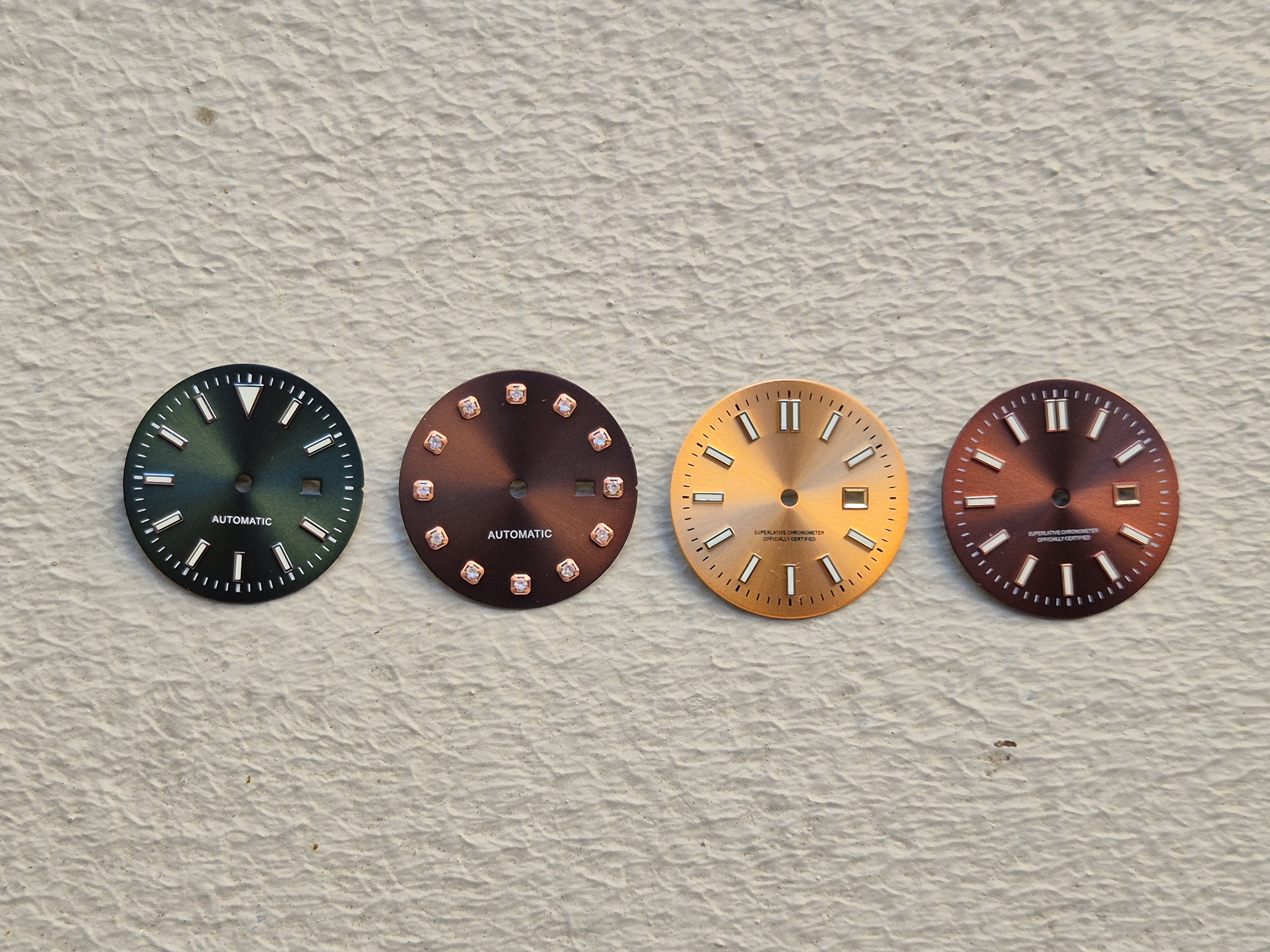
The dial is what you read when you check the time. It's a thin metal or composite disc, usually painted or printed, sometimes textured. It carries the hour markers, the brand name, often a date window or small sub-dials. Everything you can see through the crystal except the hands is the dial.
Dials are where personality lives. The same Seiko NH35 movement, in the same case, with different dials becomes three entirely different watches. We carry — among many others — sunburst, matte, applied-indices, painted-indices, skeleton, gilt, vintage tropical, and lume-heavy dive dials. Colour-wise: black, navy, white, cream, salmon, chocolate, every shade of green and blue that's currently being made.
Dials are also where things go wrong if you're not careful. A scratch on a dial is permanent. You can polish a case, replace a crystal, swap out a strap — but a damaged dial is a new dial. Ash has scratched dials. Everyone who has assembled enough watches has. We teach the dial-fitting stage with the most patience of any step in the class for exactly this reason.
Hands
A standard three-handed watch has an hour hand, a minute hand, and a seconds hand. They sit concentrically on the dial — three tiny pinions on the same axis at the centre.
Hand shapes have names with histories. Dauphine hands are sharp triangular profiles, classic dress watch territory. Sword hands are slim with a central ridge. Mercedes hands are the rounded three-prong design Rolex uses on the Submariner. Snowflake hands are Tudor's signature. Syringe, baton, pencil, plongeur (the chunky orange-tipped diver's hand) — each carries an aesthetic and a heritage.
Many hands carry lume — a luminescent compound that absorbs light during the day and glows in the dark. The two main types are Super-LumiNova (most modern watches) and tritium gas tubes (used on military-style watches like the Marathon or the Ball brand). Lume is purely functional in a dive watch and purely aesthetic on a dress watch, but both kinds are fun to charge in the sun and check at night.
Hand-setting is the most precision-critical part of any build. The hands have to sit flat against each other without rubbing, with the hour hand sitting just above the dial and the seconds hand sitting just above the minute hand. We set hands one at a time with watchmaker's tweezers and a hand-press. Hurry this step and you'll spend the next hour redoing it.
Crown
The crown is the small knob, usually at three o'clock, that you pull out to set the time and date. It's connected to the movement via a thin shaft called the stem, which runs through a hole in the case and engages with the winding mechanism.
On a manual watch, you wind the crown to tension the mainspring. On an automatic, you can still wind manually if the watch has been off the wrist for a few days. On a dive watch, the crown often screws down — when fully tightened, the crown forms a watertight seal against the case. This is what gives a dive watch its water resistance: the crown seal, plus a gasket around the case back, plus the gasket under the crystal.
The crown design is often where a watch's personality announces itself. A polished onion crown on a dress watch. A heavy knurled crown on a pilot's watch. A small recessed crown with crown guards on a sports watch.
Movement
The movement is everything that makes the watch tick. We covered this in detail in How a mechanical watch actually works — the mainspring, gear train, escapement, balance wheel, and rotor. In a finished watch you can't see the movement unless the case has a sapphire display caseback (a transparent back) or unless the dial itself is skeletonised (cut away to show the gear train, as on the Seiko NH70 we use for our Premium tier).
Movements are referred to by their calibre — a model name and number. The Seiko NH35 is a calibre. So is the ETA 2824, the Valjoux 7750, the Rolex 3235. Within a calibre, individual movements are physically interchangeable as long as the case is designed for that movement.
Movements come in three flavours: manual (you wind it daily by the crown), automatic (a rotor on the back winds it as you move), and quartz (a battery and crystal oscillator drive a small motor). We only use mechanical automatic movements at the bench, because the whole point of the class is the experience of building something that runs on physics rather than electronics.
Caseback
The caseback closes the bottom of the case. Most are screw-down (a threaded ring that compresses a gasket as it tightens — gives the watch its water resistance) or snap-on (pressed in by hand and held by tension, common on cheaper watches and easier to open for service).
The caseback is often where the watch's character details live. Engraving — brand name, serial number, water resistance rating, "swiss made" or "made in japan". Sometimes a display window of sapphire showing the rotor swinging. On more thoughtful watches, custom engraving for an occasion or owner. Casebacks are also where most service work begins — opening the watch starts here.
Bracelet or strap
The bracelet is the metal band; the strap is the leather, rubber, or fabric one. They attach to the lugs via spring bars, and both can be swapped out in two minutes with the right tool. A single watch case, with three different straps in your drawer, becomes three different watches across a week.
Common bracelet styles include the Oyster (Rolex's three-link sports design, square and sturdy), the Jubilee (five-link, dressier, more sparkle), the President (three-link, semi-circular, the most formal bracelet), the Engineer (square and bold, BVLGARI signature), the Beads of Rice (vintage-feel, lots of tiny beaded segments), and the integrated bracelet (one continuous line from case into bracelet, AP Royal Oak and Patek Nautilus territory).
Straps include leather (calf, alligator, Horween), rubber (FKM is the durable modern standard, silicone is softer), fabric (NATO, Perlon, single-pass elastic), and many specialty options. Lug widths must match. A 20mm lug width takes a 20mm strap, end of conversation.
Spring bars
Spring bars are the tiny sprung pins that hold the bracelet or strap to the case. They are roughly 1.8mm in diameter and 20–22mm long, with a small spring inside that lets the ends compress so they can be fitted between the lugs and then released to lock into the small drilled holes inside the lugs. They are unglamorous and indispensable. They are also the part most likely to fail — a worn spring bar is the most common reason a watch ends up on the floor.
Spring bar tools — small forked pry instruments — are part of our standard kit. We replace spring bars on every fresh build as a matter of course. They cost almost nothing and they are the difference between a watch you can wear and a watch that ends up under your couch.
Things you might also encounter
Sub-dials — smaller dials inside the main dial, used for additional complications like running seconds, chronograph timers, day-date displays, or moon-phase indicators.
Pushers — small buttons on the case (usually flanking the crown) used to operate complications, most commonly to start, stop, and reset a chronograph.
Tachymeter — markings around the bezel that let you calculate speed over a fixed distance. Famous on the Omega Speedmaster and most racing chronographs.
Crown guards — small wings on either side of the crown protecting it from impact. A signature of dive and sports watches.
Date wheel — a disc inside the movement showing through a small window in the dial, advancing one day every twenty-four hours.
Helium escape valve — a tiny one-way valve on the side of some saturation-dive watches that lets helium gas escape during decompression. Marketing relic on every dive watch sold today; engineering necessity on roughly six watches ever made.
Why this matters for a build
Every part above is a choice. The same Seiko NH35 movement, inside a 36mm classic case with a sunburst silver dial, applied indices, dauphine hands, and a black leather strap, becomes a dressy watch you'd wear to a wedding. The same movement, inside a 40mm dive case, with a matte black dial, mercedes hands, a unidirectional dive bezel, and a steel Oyster bracelet, becomes a sports watch you'd wear in the surf. Same engine. Different watch.
This is what we mean when we say there are 1.7 million possible combinations across our launch inventory. The choices compound. The watch you build at the bench is yours — not because we slapped a logo on it, but because every decision in the design came from you.
Build the watch you want. Saturdays and Sundays in Surry Hills, Sydney. We walk you through every part above and let you pick the combination that becomes your watch.
Reserve a bench