Watch dials, explained.
More than any other component, the dial decides what a watch looks like. The hands move, the bezel rotates, the bracelet flexes — but the dial sits still, getting glanced at a hundred times a day, and the choices you make about its finish, colour, and markers determine the watch's whole personality.
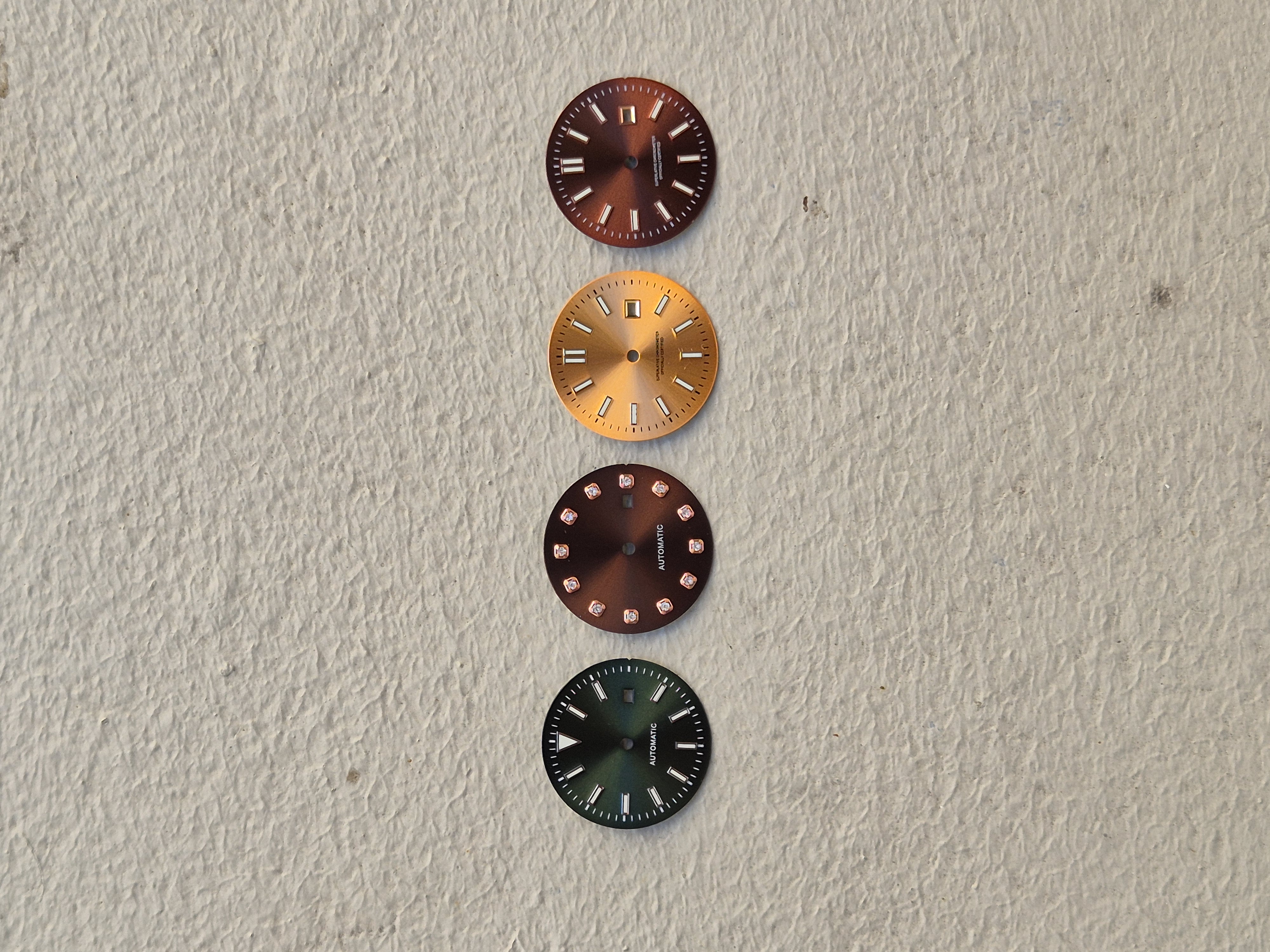
Dial finishes
Sunburst (or sunray)
The most popular modern finish. Tiny radial brush-marks emanate from the centre of the dial, creating a sunburst pattern that catches light dramatically. As you tilt the watch, different sections of the sunburst pattern catch light and others fall into shadow, producing the visual depth that's the trademark of high-quality sports and dress dials.
Sunburst dials are produced by polishing radial lines into the dial blank before lacquering. The lacquer is then applied transparently so the texture shows through, creating both colour and visual movement at once. Black, navy, green, salmon, and gold sunburst dials are all common at the bench.
Matte
The flatter, more sober alternative to sunburst. A matte dial reflects light evenly across its whole surface — no bright spots, no dark spots, no movement of light when you tilt the watch. The aesthetic is military, tool-watch, or restrained dressy depending on the rest of the build.
Matte dials are produced by either fine sandblasting the dial before lacquering, or using a matte lacquer formulation directly. Tool watches and pilot watches usually run matte. Vintage military reproductions invariably do.
Skeleton (or openworked)
A skeleton dial has the centre cut away, exposing the movement underneath. The dial functions as a frame for the openworked centre rather than a continuous surface. Pair a skeleton dial with an NH70 movement and you can watch the gear train turn while the seconds hand sweeps across it.
Skeleton dials are usually thinner than solid dials and more delicate to handle during assembly. The hands need to be carefully clearance-checked — they're sweeping over the cut-away section and the gear train sits closely below.
Gilt
Gilt dials have markings printed in glossy black on a coloured dial (usually black), with the printing protected by a clear lacquer coat that fills in between the printed marks. The lacquer dries with a slight raised effect over the black areas, producing the warm, slightly antique look associated with 1950s-60s vintage Submariners and Explorer-style watches.
True gilt requires a thicker dial than modern flat dials and a more complex production process. Modern aftermarket gilt dials reproduce the look using printing techniques that approximate the original effect at modern prices.
Vintage / tropical
A vintage or tropical dial is finished to look aged — usually a slightly faded or yellowed cream-on-cream colour, with patina effects baked into the printing. Real tropical dials are vintage watches whose dials have actually faded; aftermarket tropical dials reproduce the look intentionally.
Lacquered (or "piano")
A deeply glossy black or coloured dial with multiple coats of high-gloss lacquer producing a mirror-like surface. Common on dress watches. The trade-off: every fingerprint shows immediately, and the slightest scratch is impossible to hide.
Indices — what the hour markers are made of
Painted (printed) indices
The cheapest and most common. The hour markers are printed onto the dial surface in white, gold, or contrasting paint. They sit flush with the dial. Easy to manufacture, easy to design, infinite colour options. Almost all entry-level dials use painted indices.
Applied indices
Individual metal indices, separately manufactured and glued or pinned to the dial surface. Applied indices catch light differently from the dial below — usually polished or brushed metal sitting above a sunburst or matte surface. The visual depth is substantially greater than painted indices.
Almost every high-end watch uses applied indices. They're a signature of quality: you can tell at a glance whether a dial is painted or applied just by tilting the watch and watching how the indices catch light.
Lume indices
Indices filled with a luminescent compound (Super-LumiNova or tritium). Glow in the dark after exposure to light. Standard on dive watches and field watches where readability at night matters. The lume is applied as a paste that's then sealed under a transparent coat.
Crystal indices
Indices set with small crystal stones — often diamonds on luxury watches, cubic zirconia or rhinestone on more affordable ones. The crystals catch light dramatically and add a jewellery feel to the dial. Common on women's watch designs.
One of the dials in our parts library is a brown sunburst with crystal indices. It's been popular at the bench among students looking for a dressy build with sparkle.
Lume — luminescent paint
Lume is the luminescent material on watch hands and indices that makes them glow in the dark. There are three main types in modern watchmaking:
Super-LumiNova (Swiss) — the modern standard. Strontium aluminate phosphor that charges from light exposure and glows green or blue for hours. Used on essentially every modern Swiss and Japanese mechanical watch. Non-radioactive.
LumiBrite (Seiko's variant) — Seiko's proprietary version of the same technology. Functionally similar to Super-LumiNova; performance varies by exact formulation.
Tritium — a radioactive isotope of hydrogen, sealed inside small glass tubes (called "trigalights" or "tritium tubes") that glow continuously for 25+ years without needing light exposure. Common on military watches (Marathon, Ball Watch Company) where pre-charging isn't possible. The radiation is contained and safe.
Older watches used Radium-based lume (genuinely radioactive and hazardous) or Promethium. Both are deprecated; if you see them on a vintage watch, handle with care and don't open the case without professional protective equipment.
Colours and what they say
The colour of a dial communicates more than any single design element. A quick taxonomy:
Black — sporty, masculine, default. The most-built colour at the bench.
White / silver — dressy, traditional, formal. Common on dress and pilot watches.
Navy / blue — sporty without being aggressive. Often the second-most-popular colour.
Green — modern, slightly sporty, the colour of the 2020s. Increasingly popular.
Salmon / pink — vintage dressy, increasingly popular among modern collectors. Hard to wear casually.
Chocolate / brown — warm, slightly retro, a strong choice with leather straps and rose gold cases.
Gold / champagne — luxurious, slightly dated for some, sumptuous for others.
Grey — modern minimalist. Pairs with steel cases and brushed bracelets.
Red — sporty, racing, attention-getting. Rare on dressy builds.
Cream / off-white — vintage, warm, dressy. The colour of 1950s dress watches.
How dials interact with hands
A dial and its hands have to coexist visually. Dark hands on a dark dial disappear. Light hands on a light dial disappear. Most builds choose a dial-colour-versus-hand-colour contrast strategy:
Light dial, dark hands — classic dress watch.
Dark dial, light hands — classic sports/diver.
Dark dial, gold hands — gilt vintage style.
Light dial, gold hands — warm dressy.
Same-tone hands and dial — subtle and challenging, only works with strong lume to compensate.
At the bench, when students pair a dial with hands, the contrast question is the first one we test. We hold the hands above the dial under workshop light. If they "pop", the build works. If they merge, we re-select.
The dial is the build's personality
Every other component is functional. The case protects the movement. The crystal protects the dial. The bracelet holds it on your wrist. The dial is the only component that's there purely to be looked at. It's the only one that decides what people see when they glance at your watch.
This is why the dial is the part of the build most students spend the longest on. Pick the dial wrong and the watch is wrong — even if every other choice is right. Pick the dial right and the watch is yours, even if everything else is standard.
Pick a dial from the library. Hundreds of options across sunburst, matte, skeleton, gilt, vintage, and crystal-indexed dials. Foundation tier $595, Premium $795.
Reserve a bench