Inside a movement.
If you've read our explainer on how a mechanical watch works and you want the next layer of detail — the gear ratios, the hairspring physics, the geometry of the escapement, the small choices watchmakers have made and unmade for three centuries — this is where we go deeper.
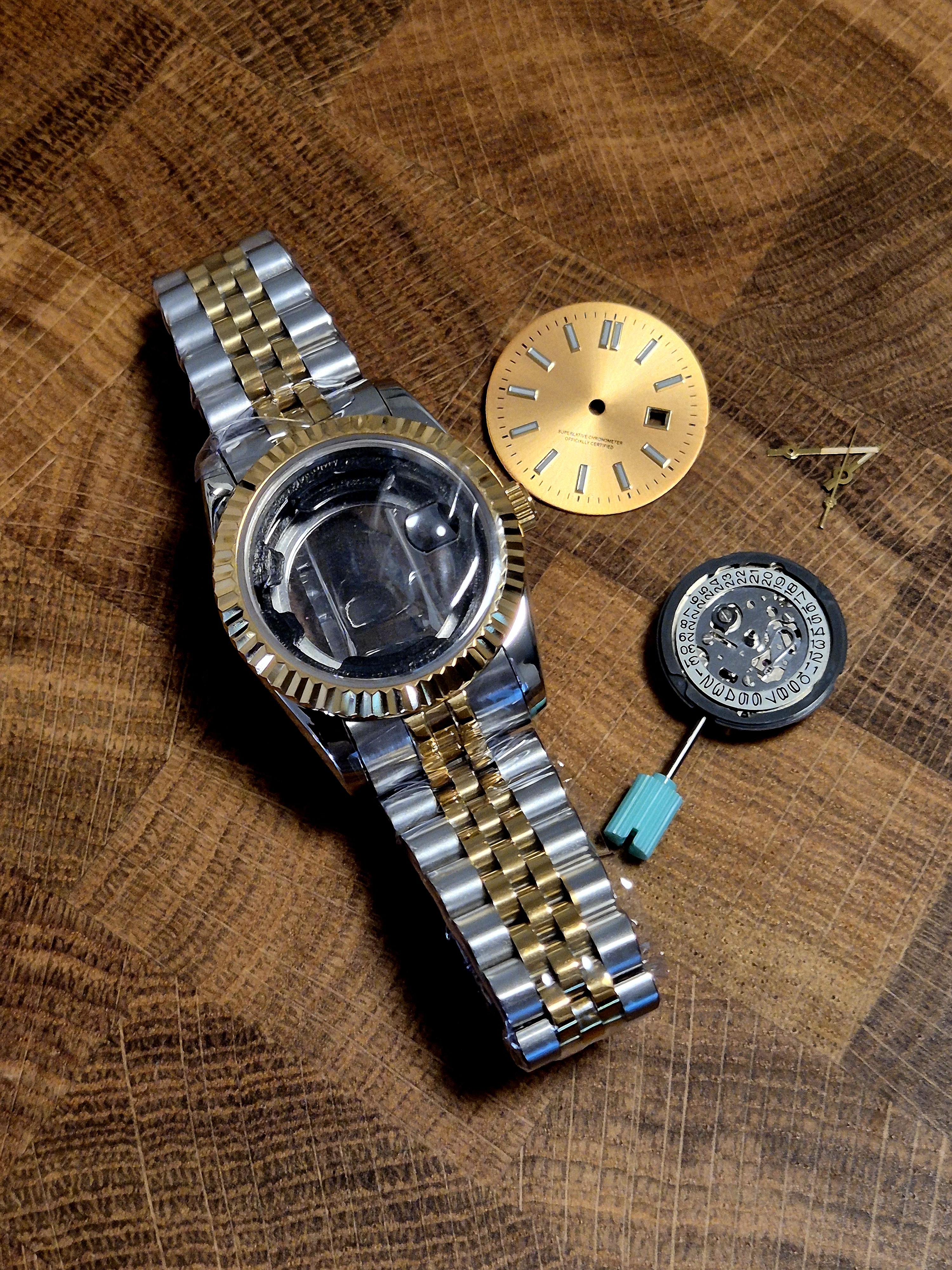
This article assumes you know the basics
If you're brand new to mechanical watches, start with How a mechanical watch actually works — that piece walks through the five major components from the top. This one assumes you already understand what a mainspring, gear train, escapement, balance wheel, and rotor are at a high level. We're going to look at how they actually fit together — the physics, the geometry, and the small engineering decisions that turn five parts into a functioning timekeeper.
The mainspring is a battery
Think of the mainspring not as a spring in the everyday sense but as a chemical battery storing potential energy. A fully wound mainspring on a Seiko NH35 stores roughly 0.4 joules of energy — about the same as a triple-A battery delivers in eight minutes of LED-flashlight operation. That tiny amount has to power the entire watch for 41 hours.
The shape of the mainspring matters enormously. A traditional mainspring is rolled flat ribbon steel, around 1.4 metres long when fully unrolled in the NH35's case, wound concentrically inside the mainspring barrel. The cross-section is engineered to deliver torque that's roughly constant across the unwinding cycle — a problem watchmakers have been refining since the 17th century. An early spring delivered enormous torque when fully wound and almost none near the end. Modern springs deliver a near-flat torque curve through ninety percent of the reserve, then drop off sharply in the last few hours.
This matters for accuracy. The balance wheel oscillates differently under high torque versus low torque (it swings wider when energy is plentiful). A flat torque curve from the mainspring means a more consistent balance amplitude, which means more consistent timekeeping over the watch's reserve. The difference between a watch that keeps time to +/-5 seconds per day and one that keeps time to +/-20 seconds per day is often the mainspring's torque curve.
The mainspring barrel is a small cylindrical case that holds the spring. It has an axle running through its centre (the barrel arbor) which is what you turn when you wind the crown. The barrel itself turns slowly on its outer surface — the outer face is gear-toothed, and those teeth are what mesh with the first wheel of the gear train.
The gear train is a transmission
Between the mainspring barrel and the escape wheel sits the gear train — a sequence of progressively smaller, progressively faster-spinning wheels that step the mainspring's slow output up into the high-speed motion the escapement needs. The principle is identical to a bicycle drivetrain, but reversed: instead of pedalling fast to drive a wheel slowly, the barrel turns slowly to drive the escape wheel fast.
In an NH35 the gear train consists of:
- The centre wheel — turns once per hour. The minute hand sits on this wheel's pinion.
- The third wheel — turns once every several minutes.
- The fourth wheel — turns once per minute. The seconds hand sits on this wheel.
- The escape wheel — turns approximately once every ten seconds, releasing tooth by tooth into the escapement.
The gear ratios are precise. The mainspring barrel turns once roughly every six hours. To get the centre wheel turning at one revolution per hour, you need a 6:1 step-up. To get the seconds wheel turning at one revolution per minute, you need a further 60:1 step. Each step happens through a wheel-and-pinion pair, with the larger wheel driving a smaller pinion fixed to the next wheel above.
The total step-up from barrel to escape wheel in an NH35 is roughly 1:2,160 — the escape wheel turns about 2,160 times for every one rotation of the barrel. That ratio is determined entirely by the gear ratios in the train, and it's what allows a single coiled spring to drive the escape wheel at the speed the balance wheel can regulate.
One more wheel sits in the train but doesn't carry hands: the hour wheel. The hour wheel doesn't connect directly to the gear train's main flow. Instead, it sits concentrically with the centre wheel and is driven through a small additional reduction — a 12:1 step that converts one rotation per hour into one rotation per twelve hours. The hour hand sits on the hour wheel's pipe.
This is why if you look at a bare movement from the dial side you'll see three concentric pinions at the centre: the seconds pinion (fast), the minutes pinion (middle), and the hour pinion (slow). The three hands stack on these three pinions, each turning at its own ratio.
The escapement is the genius part
If everything before this point is engineering, the escapement is design. It is the part of a mechanical watch that took centuries to perfect, and the part that distinguishes one quality of watch from another more than any other component.
The Swiss lever escapement — the design used in essentially every quality wristwatch made since around 1855, including all the Seiko NH-series calibres — works on a deceptively simple principle. The escape wheel wants to turn continuously, driven by the gear train. The pallet fork sits above it, with two small jewelled tips called pallet stones that take turns blocking the escape wheel's teeth. When one pallet stone is in contact with a tooth, the escape wheel is locked. When the pallet fork rocks to the other side, the wheel jumps forward by one tooth before being caught by the other stone.
The pallet fork doesn't move on its own. It's nudged into rocking by a small jewel on the balance wheel called the impulse jewel. As the balance wheel oscillates past the pallet fork on each swing, the impulse jewel knocks the fork into rocking — releasing the escape wheel for one beat, then letting it catch on the next.
The genius of this design is that energy flows both directions. The escape wheel pushes the pallet fork (energising the balance wheel through the impulse jewel), but the balance wheel also pushes the pallet fork (releasing the escape wheel). The balance wheel both regulates the rate and receives a small kick of energy on each swing to keep going. The escapement is simultaneously a brake on the gear train and a delivery system for the balance wheel's energy. It's a one-component solution to two problems.
The balance wheel is a pendulum
The balance wheel does for a watch what a pendulum does for a grandfather clock: it provides a constant-frequency oscillation that the rest of the mechanism uses as its time reference. In a pendulum clock, gravity provides the restoring force — the pendulum swings back to vertical because gravity wants it there. In a watch, gravity is unreliable (you carry the watch around at every angle), so a coiled spring provides the restoring force instead.
The spring is called the hairspring — a fine spiral coil of metal alloy, attached at its inner end to the balance wheel's axle and at its outer end to a fixed stud. As the balance wheel rotates, the hairspring winds up tighter on one side; when it reaches the limit of its rotation, the hairspring pulls it back. It oscillates back and forth at the spring's natural frequency.
That frequency is what makes the watch keep time. On an NH35, the hairspring is tensioned so the balance wheel oscillates at exactly 21,600 beats per hour — 6 oscillations per second, or 3 complete back-and-forth cycles per second. Multiply that by the escapement's tooth-spacing on the escape wheel, multiply by the gear ratios, and you arrive at one second per second on the dial.
The hairspring is the single most temperamental component in any mechanical watch. Its frequency is affected by temperature (heat softens the metal slightly, lowering the spring constant), by humidity, by magnetism, by gravity (the spring deforms slightly under its own weight, especially when the watch is positioned dial-up versus crown-down). Watchmaking history is largely the history of trying to make the hairspring less temperamental. The breakthrough alloys of the late 20th century — Nivarox, Parachrom, Spron — were specifically engineered to resist temperature and magnetic effects on the hairspring.
On a Seiko NH35, the hairspring is Spron 510 — Seiko's proprietary alloy, developed in-house. It's not as exotic as the silicon hairsprings used in some premium Swiss movements, but it's stable enough that a regulated NH35 holds time within +/- 5 seconds per day across most positions and reasonable temperature ranges.
"Watchmaking history is largely the history of trying to make the hairspring less temperamental."
Regulation is hairspring length
When we regulate a watch on the timegrapher at the end of every class, what we're doing is changing the effective length of the hairspring. A shorter spring is stiffer and oscillates faster. A longer spring is softer and oscillates slower. The watch runs fast or slow accordingly.
The regulator on most watches is a small lever above the balance wheel with two pins or a slot that grips a section of the hairspring. Sliding the regulator one way pinches off a small amount of hairspring (effectively shortening it, speeding the watch up). Sliding it the other way frees a small amount (lengthening it, slowing the watch down).
This is a precise but tiny adjustment. Moving the regulator by half a millimetre on an NH35 changes the daily rate by roughly five to ten seconds per day. A skilled regulator can dial in a movement to within plus or minus two seconds per day in a single position. Getting it within plus or minus two seconds across all positions (a chronometer-grade tolerance) takes hours of careful work and a movement designed to support that level of precision. The NH35 isn't a chronometer-grade calibre, but it can be regulated to extremely good amateur tolerances with a timegrapher and patience.
Isochronism is the deep problem
One of the central problems in watchmaking is the fact that a hairspring's frequency depends slightly on its amplitude — how wide the balance wheel swings. A wider swing produces a slightly different period than a narrower swing. This effect is called isochronism error, and it's why a watch's rate changes as its mainspring runs down (lower torque = lower amplitude = slightly different rate).
Modern watchmaking has spent two centuries fighting isochronism. The shape of the hairspring's terminal curves (the part of the spring closest to the regulator) can be engineered to compensate for amplitude changes — Phillips curves, Breguet overcoil, various proprietary geometries. The materials of the hairspring can be selected to minimise the elasticity change at different amplitudes. The mainspring torque curve can be flattened to reduce amplitude variation in the first place.
The Seiko NH-series uses a flat-spring design (no Breguet overcoil) and a basic regulator. It achieves its accuracy through tight manufacturing tolerances and consistent quality control, rather than through exotic geometry. This is the right design trade-off for a high-volume movement at a low price point. A chronometer-grade movement at ten times the price would use a more sophisticated hairspring geometry to chase a few extra seconds per day of accuracy.
The rotor adds energy back
An automatic watch differs from a hand-wound watch only in that a small additional mechanism — the rotor — feeds energy back into the mainspring as the watch is worn. The rotor itself is a half-disc of heavy metal (usually tungsten alloy) mounted on a central pivot on the back of the movement. As the watch moves, the rotor swings on its pivot. The swing is converted to rotational motion of a small pinion that engages with the mainspring via a clutch arrangement.
On the NH35, the rotor winds the mainspring through a one-way clutch — the rotor turns freely in one direction and engages the winding mechanism only in the other. This was a famous Seiko design decision (called the Magic Lever) and it's part of why the NH-series feels different to wear than a Swiss automatic. Other movements use a two-way clutch that winds in both directions of rotor motion. The Magic Lever is mechanically simpler but slightly less efficient — Seiko traded efficiency for fewer parts and lower cost.
In practice, on an average wrist, the rotor winds the mainspring more than enough to replace what the gear train consumes through the day. Take an NH35 off your wrist at bedtime and put it on a watch winder if you want, but you don't need to — it'll happily run for 41 hours without input.
Jewels are bearings
You'll see watches described by their jewel count — the NH35 has 24, the NH70 has 22, vintage Seiko 5s had 21, dress watches sometimes claim 28 or 31. These aren't decorative. They're synthetic ruby bearings (synthetic corundum, doped with chromium for the red colour) used as pivot bearings throughout the movement. Steel pivots running in steel holes wear quickly under the constant motion of a watch — the friction is small but it's running continuously for years. Ruby is harder than steel and wears almost not at all, so the pivots stay accurate over decades.
The major jewels in any modern movement are at:
- The balance wheel staff (two — one at each end of the balance wheel's axle)
- The pallet fork pivots (two)
- The pallet stones themselves (two — these are the surfaces that contact the escape wheel teeth)
- The impulse jewel on the balance wheel (one)
- Each gear-train wheel pivot (one at each end of each wheel — typically eight to twelve jewels here)
- Sometimes additional jewels in the keyless works (the crown-stem-clutch area)
That total adds up to the headline number on the dial. More jewels generally indicates a better-finished movement — but past a certain point, the additional jewels are in non-friction-critical positions and don't actually improve accuracy. The 24 jewels of an NH35 are roughly the right count for a robust, well-bearing movement. Movements claiming 30+ are sometimes adding jewels in places that don't need them, for marketing rather than engineering reasons.
Where the NH-series sits in the world
The NH-series isn't the world's best-engineered movement family. The Patek Philippe calibre 240 is more accurate, more beautifully finished, and more sophisticated in its hairspring design. The Rolex 3235 is more shock-resistant and uses a proprietary Chronergy escapement that wrings a few more hours of reserve out of the same mainspring. The Grand Seiko Spring Drive is a fundamentally different and arguably superior technology.
What the NH-series is is a beautifully engineered mass-production movement, designed to deliver 90% of those movements' real-world performance at 2% of their price. Seiko built the NH-series to populate the entry-level mechanical market and they succeeded by an order of magnitude. There is no other mechanical movement in the world that delivers this much craft per dollar.
When you sit down at the bench and assemble an NH35, you are building with the most-engineered $50 component in the global watch industry. Every gear ratio, every jewel position, every escapement geometry has been refined across millions of units produced. The movement isn't fancy. It's good — and good is harder than fancy.
See it for yourself. Build an NH-series watch at the bench in Surry Hills. You'll handle the movement, the gear train, the balance wheel — and we'll explain the physics as you go.
Reserve a bench